
I don't think we can predict just what will happen if the average global temperature goes up (or down) x degrees. And I don't think its clear what we need to do to institute a policy guaranteed to control or mitigate any potential negative effects. I plead the usual excuse, "more research is needed."
The global weather machine is very complex, with many parts, and has many feedback mechanisms built in, both positive ones that threaten to spiral out of control, and negative ones that tend to damp out and mitigate the effects of oscillations. Which will eventually prevail is impossible to tell.
To complicate things, the climate is undergoing constant changes, both global and localized, long- and short-term, all the time due to perfectly natural causes. The role of man-made drivers is not clear.
I personally feel it is not obvious what we need to do, if anything, to solve this problem, or even if there is a long-term problem. What makes me an activist and so concerned about it, what really infuriates me, is the apparent determination of some to deny the problem might even exist, and to attack and ridicule those that are concerned about it due to their own selfish ideological and economic reasons.
Meanwhile, since you brought it up, the November numbers just came out today. We may not know exactly what is going on, or exactly what to do about it, but something IS going on, and we need to do SOMETHING about it.
http://nsidc.org/arcticseaicenews/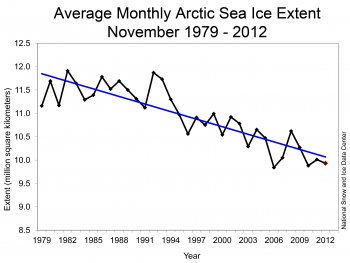
Average sea ice extent for November 2012 was the third lowest in the satellite record. This marks only the third year in the satellite record that November extent was below 10 million square kilometers (3.86 million square miles). Through 2012, the linear rate of decline for November Arctic ice extent is -4.8% per decade relative to the 1979 to 2000 average.
Its cold in the arctic in November, the sun is low and you expect there to be a lot of ice on the water. But it seems that every year there's a little less, even in winter. I think its safe to say that counts as a trend. And remember, the drop in the warmest month, September, is -13% per decade.
