
The Horsehead is just a little piece of the huge molecular cloud complex that covers a large part of Orion, over a thousand light years away. They are called molecular clouds because of the presence of numerous molecules in the gas, particularly H2, in addition to the ubiquitous ionized gases. It is clearly visible because it is illuminated by the bright blue light of nearby hot blue supergiants that have recently formed (in the last few million years). The red glow is emission from the monatomic (ionized) hydrogen in the cloud excited by UV light from these super hot stars. The blue glow is light reflected and scattered by dust formed by condensation of metals and minerals from the stars that have already rapidly evolved off the main sequence, their supernovae and planetary nebula stages adding material to the interstellar medium.
It is thought that the surfaces of these dust grains form a substrate upon which atoms find shelter from the radiation and form complex compounds, even organics, like water, carbon dioxide, ammonia, methane, alcohol, urea, and many others. About a hundred compounds have been identified spectroscopically in these stellar nurseries. Our sun, and life, were formed in a place like this.
This is why there is so much interest in capturing pristine meteoritic and cometary material. These are the mechanism by which these organics are transferred from the interstellar medium to planetary surfaces. "Real primordial stuff".
Its not just a pretty picture. We are looking at the birthplace of creation here, the lathe of heaven. And everything I have mentioned in this post has been learned since I became an astronomy student in the 1960s. It's an exciting time to be alive.
The little red smears in the galaxy map below are other molecular clouds and HII regions like the one in Rob's post.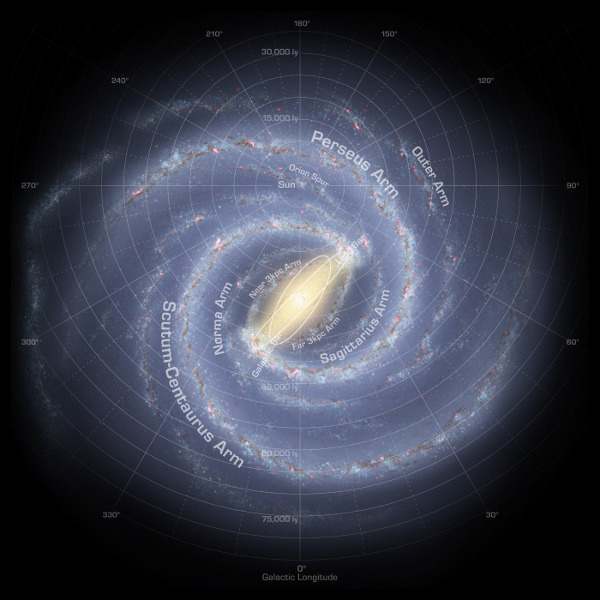
Space/Science » in reply to New Hubble image of the Horsehead Nebula
phenomenal