
I was just a kid when color film emulsions fast enough for astrophotography were first developed, Life Magazine did a photo essay with about a half dozen photographs taken through the Hale 200" reflector at Mt Palomar--at that time, the largest telescope in the world, twice the aperture of its nearest rival, the Hooker instrument at Mt Wilson.
The Ring Nebula looked very much the same in that picture as the Hubble image, (in spite of advances in image processing) although the latter shows much more detail due to its much higher resolution. My guess is this image was processed for natural color like the film emulsion, not false-colored to bring out details in the infrared. The difference between the two is mostly due to our atmosphere. The Hubble mirror is half the size, and collects 1/4 the amount of light, of the Hale.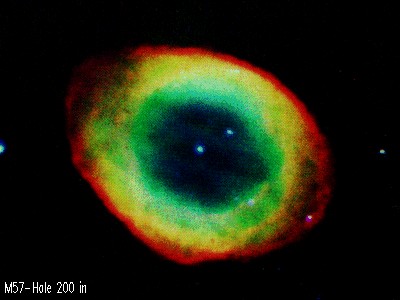
Sadly, both the Hale and Hooker instruments may soon be joining the Hubble for decommissioning. Although mechanically and optically flawless, and upgraded with the latest detector technology, both of the great California reflectors are now performing way below specs due to encroaching light pollution.
The Hooker, in particular, will be a great loss. This is the telescope Hubble used to prove our Milky Way was just one of an infinitude of galaxies in an expanding universe, not the whole of creation as previously believed. Even today, almost a century after it was built, the figure of the 100" mirror is considered of exceptional quality, good enough for astrometic work. Most large reflectors are designed to be primarily light buckets, to photograph faint objects. High costs prevent large mirrors from being precision-ground for high resoultion, super-sharp images when they are primarily used for spectroscopic work where resolution doesn't matter.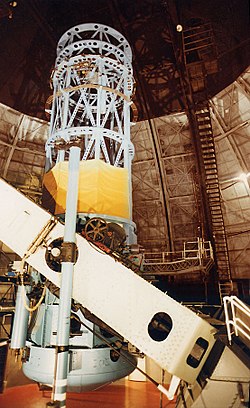
Space/Science » in reply to Gray Donut
Bringing it all back home.