
We could sprinkle ashes and soot from our fossil fuel economy on it. Ash/soot, volcanic or industrial, increases albedo when in suspension in the atmosphere, but decreases it when lying on snow.
The problem is the earth climate machine is very complex. Its hard to predict what, if any, effect any specific action will have, perhaps even one totally opposite of what you might expect. Global warming might even precipitate a new ice age. It may have happened in the past, there's no reason it can't happen now, even without our help.
The climate does seem to be self-correcting through multiple feedback mechanisms, but it is also riddled with tipping points that can unexpectedly lead to runaway excursions.The stability of the entire system varies depending at which time resolution you look at. I think the hip new word is "granularity".
All we know for sure is that for the last few centuries things have been warming up very fast, by geological standards. And in the last generation, the one indicator which is most sensitive and which can be unambiguously and reliably monitored (Arctic ice) has apparently redlined.
Look at those regressions superimposed on the September data I've been posting. The first ice free arctic summer could occur at any time, and unless some negative feedback mechanism kicks in to turn things around, the arctic will be ice free every summer in about 20-30 years at most. Just follow that blue line until it intercepts the x-axis. Summer ice has been melting at the rate of 13% per decade. Since the satellites have been monitoring (1979), almost HALF the summer ice has vanished.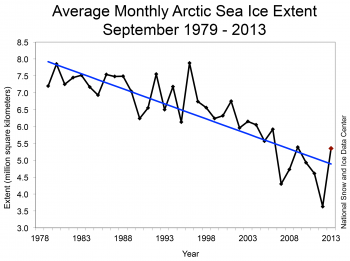
Of course, the arctic will always be iced over in winter, because that's when the sun doesn't shine. But having a high albedo doesn't help the overall heat budget much when its totally dark outside.
Space/Science » in reply to Equilibrium . . .
Decreasing albedo by darkening snow...