
See below* for a short essay describing the experience.
I did a lot of dinghy sailing in my 20s, usually with one crew(for the most part, a green hand). But I did solo every now and then. My first boat was a San Francisco Pelican.
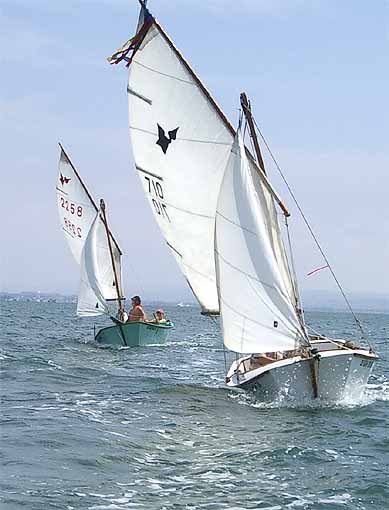
I got my second boat (a Venture/Macgregor 22) when I lived in the San Francisco Bay area, which I usually sailed with at least one crew. The Bay is a litle inland sea, with all sorts of neat places to go. And the fogs, tides, currents and winds there are like no other inland body of water in the world. As the locals like to say, "If you can sail the Bay, you can sail anywhere."
http://sailboatdata.com/imagehelper.asp?file_id=2631
I could handle either boat by myself, but launching and retrieving, anchoring, and changing sail in a blow was a lot safer with someone to help out. I did a lot of coastal cruising in the Pelican, for about 3 years, usually camping out on small islands and keys in Tampa Bay or in the Gulf, up by Anclote Key, near Tarpon springs.
I sailed the Macgregor all over San Francisco Bay for 4 years, but I never had the courage to sail her under the Golden Gate into the Pacific. She was not a blue water boat, in fact, I felt more secure in the Pelican, although she was half its size. I did crew work (navigator)on other people's boats while I was there, doing some racing in the Bay, and two long coastal cruises offshore. One was from San Francisco to San Diego, the other from Long Beach to Santa Cruz. But these were fully equipped offshore boats (an Express 37 and a Bristol Channel Cutter 28) with semi-pro crews.
I've done a lot of day sailing since, crewing on other people's boats, but by far my most profound experiences were in the Pelican. It was a small, open boat, but seaworthy enough that I often took off for several days at a time into some pretty remote areas.
*Learning the hard way
I learned to sail in the summer of 1969 — I was newly mustered out of the Navy and I had just started college in Florida. My roommate at the time, Mike, owned a house on the shores of Lake Carroll in Tampa. Our neighbors had a Sunfish that was available for our use. A Sunfish isn’t much more than a surfboard with a lateen rig, a rudimentary rudder, and centerboard. There were only two lines to learn: a halyard and sheet. a basic boat.
Mike and I often went sailing after class, and although he often offered to teach me how, I had little interest in the sport. I was obsessed with sports cars and was dedicated to competing and officiating in rallies, autocrosses, and gymkhanas. Besides, I had just been part of the navigation team of a missile frigate; somehow, mastering a 12-foot board with a triangular sail just didn’t seem to be worth my effort.
One windy afternoon, as we often did, we went for a sail. Mike raced downwind to the center of the lake and, with no warning, and even less ceremony, dove into the water and started swimming back to shore. “It’s about time you learned how to do this,” he called out as he stroked for home. I was on my own.
I had obviously not been paying attention. I could not coordinate rudder and sheet, and before I knew it, I was knocked down. That pretty much describes the rest of the afternoon — when I was not stuck in irons, luffing and going nowhere, I was usually in the water. I had seen Mike recover from a knockdown and I knew that drill fairly well, but I hadn’t realized he first maneuvered the bow into the wind and loosened the sheet prior to righting the boat. Consequently, after righting the Sunfish, I usually found myself in the water moments later, usually under the sail, but sometimes on top of it. When I finally managed to climb aboard, I usually jibed and would get knocked down again. This went on, with variations, for what seemed an eternity. I just couldn’t seem to get it to go the way I wanted, and it seemed to have a mind of its own, either stubbornly in stays, going nowhere, or scooting along ever further from home.
By this time, I had been blown clear across the lake and, on one particularly nasty jibe, I capsized completely, digging the top of the mast into the lake’s muddy bottom. I wouldn’t even be able to pull the boat up on the beach and call for help! I eventually had to swim under the boat, grab the mast and unstep it while hanging onto it upside down under water, then tie the rig to the boat so it would not sink or drift away while I righted the craft, re-stepped the mast, hoisted the sail, replaced rudder and centerboard, and figured out what to do next.
I finally got the hang of it and started to tack back to my side of the lake. It only took me a few more knockdowns and missed tacks and at least one ferocious jibe, but by the time I got to our beach, several hours later, I felt like an expert.
And I was hooked. I never felt any desire to race my car again
.