
Knowing that TRex (and a whole menagerie of related predators) started out as quadrupeds, then evolved into bipedalism, the first order answer is kind of obvious: They're vestigial, so their "purpose" is to have no purpose.
But that just pushes it back to a more basic question: Why bipedalism? More specifically, what's the advantage to a carnivore?
Carnivores catch things, so speed is a pretty good guess. But a cheetah flies along on four legs...on a flat plain.
The habitat of these carnivorous dinosaurs was often jungle-like, lots of vegetation and few flat open areas. The kind of the terrain where a four-legged sprinter has twice the chance of tangling a leg, crashing, even breaking limbs and becoming another predator's meal. Switching to half as many legs, and concentrating lots of muscle power in them, is a winning strategy.
As is having a battering-ram shaped head with a heavy skull, to break through the vegetation.
And tiny vestigial forelimbs that present a minimal profile so as to not get caught in the vines and broken.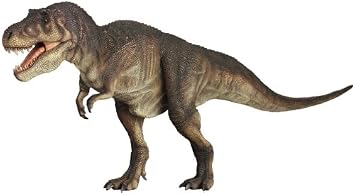
The T Rex had such tiny front legs to make it a more streamlined jungle battering ram.
Space/Science » in reply to Why did T. Rex have such tiny front legs?
Run through the jungle
The whole thread (12 posts)
- Why did T. Rex have such tiny front legs?