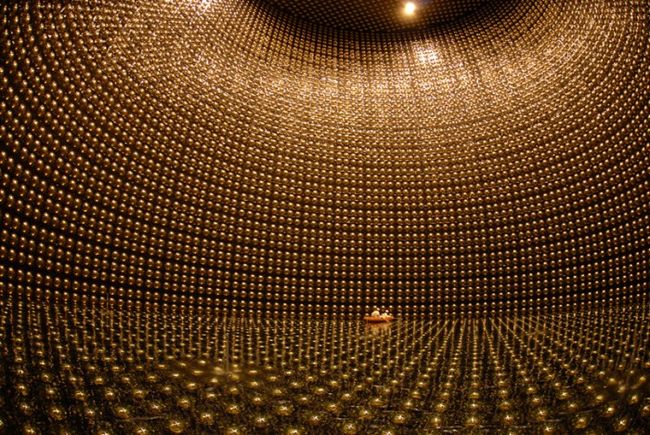
LIVE SCIENCE - April 15, 2020 | Inside a cavern, buried beneath a mountain in Japan, there's a giant tank of water that has been very still for many years. And usually nothing happens.
Every once in a while though, a ring of light flickers around the edges of the tank — the signature of an electron or a similar, but heavier particle known as a muon passing through the water. Those electrons and muons are remnants of tiny, ghostly particles known as neutrinos that slammed into the tank's water molecules in a rare interaction.
For years, the physicists of the T2K Collaboration have counted those rings of light, the only sign of a powerful neutrino beam fired through the Earth's crust into the cavern from another subterranean facility 183 miles (295 kilometers) away. As the physicists of T2K count the rings, they separate out the clearly-defined ones, produced by heavier muons charging through the water, from the fuzzy rings, which are the signatures of lightweight electrons.
Over time, the physicists have noticed a discrepancy in their count. That discrepancy, they believe, could help explain the existence of matter in the universe.
□ Matter and antimatter should mirror each other, but they don't □ Neutrinos could hold the key