
Weather for 19 Jun 2001 -- IMPACT!
IMPACT:
A solar wind disturbance swept by our planet today (June 19) between 1400 and 1430 UT. The impact could trigger renewed episodes of Northern Lights, which sky watchers spotted on Monday (see below) despite the growing twilight of northern summer.
Wade Clark:
"The auroras were visible even in relatively bright twilight. It was a lovely display!"
Photo details:
28mm f1.8 wide angle lens
Fuji NHG II 800 speed color negative film
30 second exposures
June 17-18, 2001
10:45pm - 1am PDT
AURORAS:
A dense interplanetary shock wave struck Earth's magnetosphere on June 18th and triggered a G2-class geomagnetic storm. The disturbance began its journey toward Earth last Friday when a coronal mass ejection (CME) billowed away from the Sun. Although that CME was not Earth-directed, the expanding cloud generated a "bow shock" as it plowed through the gaseous interplanetary medium, and that bow shock struck our planet's magnetic field.
The Planetary K-index rose to storm levels on June 18th.
BURSTING COMET:
Comet C/2001 A2 (LINEAR), which crumbled and brightened as it neared the Sun on May 24, 2001, is flaring once again as it heads for a late-June close encounter with Earth. Glowing at visual magnitude 3.3, the comet's fuzzy head is visible to the unaided eye and its tail is a lovely sight through binoculars, say observers. Sky watchers south of the equator can spot comet LINEAR easily in the eastern sky between 4am local time and sunrise.
(finder chart)
Australia's Gordon Garradd captured this view
of the comet's tail stretching 1.5 degrees on May 18, 2001.
(Copyright 2001, G. Garradd)
Although this comet is too far south for many of our readers to enjoy now, it will make an appearance in northern skies later this month. By June 30th (the date of the comet's closest approach to our planet at 0.24 AU) it will lie ~30 deg. above the eastern horizon before dawn as seen from mid-northern latitudes. How bright will the crumbling comet become? Watch it and see!
(3D orbit)
(ephemeris)
THE BIGGEST EXPLOSIONS IN THE SOLAR SYSTEM:
NASA's HESSI spacecraft aims to unravel an explosive mystery: the origin of solar flares.
(full story)
- ><><><>< - ><><>< - ><>< - ><><>< - ><><><>< -
Current Conditions (updated: Today at 1807 UT)
Solar Wind velocity: 634.3 km/s
Density: 2.6 protons/cc.
X-ray Solar Flares (Updated: Today at 1800 UT)
6-hr max: B9 1255 UT Jun 19
24-hr: M1 2020 UT Jun 18
Radio Meteor Rate (Updated: 17 Jun 2001)
24 hr max: 57 per hr
(Listen to the Meteor Radar!)
Sunspot Count (updated: 18 Jun 2001)
Sunspot Number: 220

- ><><><>< - ><><>< - ><>< - ><><>< - ><><><>< -
StarChild: A Learning Center for Young Astronomers . . .
The Solar System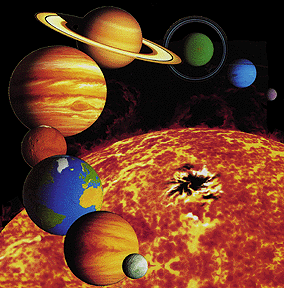
What is the solar system? It is our Sun and everything that travels around it. Our solar system is elliptical in shape. That means it is shaped like an egg. The Sun is in the center of the solar system. Our solar system is always in motion. Nine known planets and their moons, along with comets, asteroids, and other space objects orbit the Sun. The Sun is the biggest object in our solar system. It contains more than 99% of the solar system's mass. Astronomers think the solar system is more than 4 billion years old.
(Site Access)
Subscribe to Space Weather News!
Dan
Weather for 19 Jun 2001 -- IMPACT!