<
HEPAP Unveils 20-Year Plan for U.S. High Energy Physics
Volume 25 | Friday, February 15, 2002 | Number 3
By Judy Jackson
Fermilad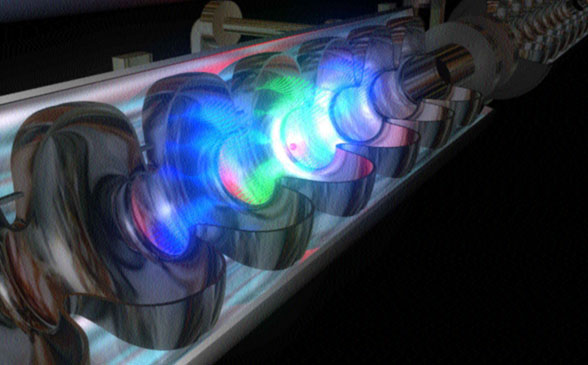
New technologies, such as these niobium superconducting structures designed to accelerate electrons to nearly the speed of light, promise to take particle accelerator science to an unprecedented level.
Photo Credit: Fermi National Accelerator Laboratory (Fermilab).
"High Energy Physics is entering an extraordinary period of discovery."
On an unusually balmy winter day in Washington late last month, the High Energy Physics Advisory Panel officially launched the plan that they hope will lead to a new era of opportunity for particle physics in the United States. Among its recommendations, the “Report of the Subpanel on the Long-Range Future of U.S. High-Energy Physics” calls for creating a system for prioritizing particle physics projects and, eventually, for building a new international particle accelerator “somewhere in the world”—preferably somewhere nearby.
The new plan is the product of a 22-member HEPAP Subpanel, charged by the Department of Energy and the National Science Foundation with the daunting task of consulting with the U.S. particle physics community to produce a plan for the future of a field that, in recent years, has been hard pressed to maintain its leading edge. Straitened federal funding for U.S. particle physics, and indeed for all of the physical sciences, has left cash-strapped physicists struggling to maintain momentum in a science where Americans have traditionally led the field. The Subpanel’s report represents, if not a consensus on the best way forward, at least as close to consensus as they are likely to get in a community where strongly held opinions are as divergent as particles in a high-energy collision. The Subpanel, chaired by physicists Jonathan Bagger, of The Johns Hopkins University, and Barry Barish, of Caltech, listened to hundreds of U.S. particle physicists from across the nation, as well as foreign colleagues, before presenting the draft of their report to HEPAP on October 29, 2001.
“We kept the process as open and interactive as we possibly could,” Barish said. “We set up a website, held open meetings and even shared a set of questions with the community. We invited input in the form of letters or face-to-face conversations with the Subpanel. The response was overwhelming! We received about 100 letters, we had many talks with our colleagues, and we heard reports from Snowmass working groups. We could not hope to satisfy all of the diverse opinions that we heard, but they were very influential in determining our recommendations.”
At the January 30 HEPAP meeting, held at Georgetown’s Latham Hotel, HEPAP Chair Fred Gilman, of Carnegie Mellon University, called for a vote of acceptance from the panel before transmitting the Subpanel’s report (.pdf format) to DOE and NSF, the federal agencies that fund high-energy physics in the United States. The "ayes" had it, unanimously.
Not all U.S. physicists had endorsed the initial October 29 draft with such unanimity, however. In particular, members of Fermilab’s BTeV collaboration interpreted its recommendations to mean the demise of their 4-year effort to bring to reality their proposal to study the physics of the B meson at Fermilab’s Tevatron. But changes to the draft left BTeV collaborators at least cautiously satisfied with the final plan. In remarks delivered at the meeting, co-spokesman Joel Butler spoke for the BTeV collaboration.
“After the October 29 release of the draft report,” Butler said, “there were several developments. The subpanel chairs, Jon and Barry, assured us that the subpanel did not intend that BTeV be killed, explained to us what they did mean, and said that they would change the words to make their intent more clear.”
(More: Fermi News Source)
2002 © Fermi National Accelerator Laboratory.
Dan
Space/Science » in reply to Saturday, I happened to tune in on Paul Harvey
HEPAP Unveils 20-Year Plan for U.S. High Energy Physics . . .