<
Morphing DNA Makes Motor
Wednesday, January 16, 2002
By Kimberly Patch
Technology Research News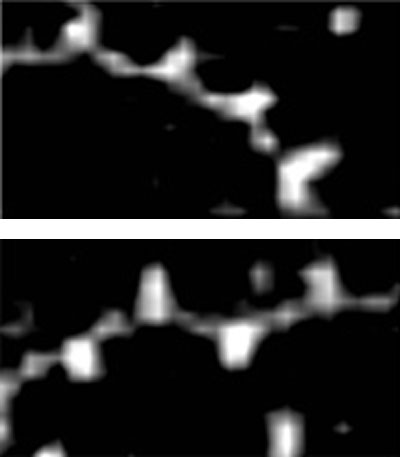
The bumps on this DNA motor each consist of three joined DNA tiles. The top image shows the bumps aligned with each other. The bottom image shows the bumps alternating directions after one cycle of the motor.
Photo Credit: New York University.
Molecular machines could be used to assemble drugs molecule-by-molecule, and molecular robots may eventually work inside the human body. It will be about a decade before the method can be used to make practical devices, said Seeman.
NEW YORK UNIVERSITY
DNA molecules are prime candidates for helping humans make microscopic machines because they have a long history of assembling things on the molecular scale. Every one of a human's 75 to 100 trillion cells exists because a DNA molecule automatically unzipped, created the duplicate a cell needs to divide, then folded itself neatly back up again.
Researchers at New York University have taken a significant step forward in being able to instruct artificial DNA molecules to move in specific ways with a method that allows certain portions of DNA to bind to each other, and then release. This reversible binding method allows for control of the shape of a DNA molecule, or machine.
The researchers demonstrated the mechanism by making a four-step rotary motor out of DNA.
The motor is a four-stranded DNA molecule that, prompted by separate strands of DNA, will go through a mechanical cycle over and over again. Because the process is a reversible cycle, there are no waste products.
The four-stranded DNA molecule is essentially a pair of double helixes of DNA connected at several points along their lengths.
When the researchers add molecules of control DNA to a solution full of the motor molecules, the short, single-stranded control molecules join with the larger molecules and rearrange them by connecting two of the double strands in one place and cutting them in another. The researchers then remove the control strands using fuel strands of DNA, which are also short single-stranded lengths of DNA. This leaves the motor molecule in a different physical shape than when it started -- the end of one double strand of the DNA is rotated 180 degrees relative to the strands next to it.
(More: TRN News Source)
2002 © Technology Research News, LLC.
Way cool!!
Dan
Space/Science » in reply to NYU Scientists Advance Toward Nanorobots . . .
Morphing DNA Makes Motor . . .