
<
Weather for 16 Mar 2002 -- Long Flare & Photogenic Comet!
LONG FLARE: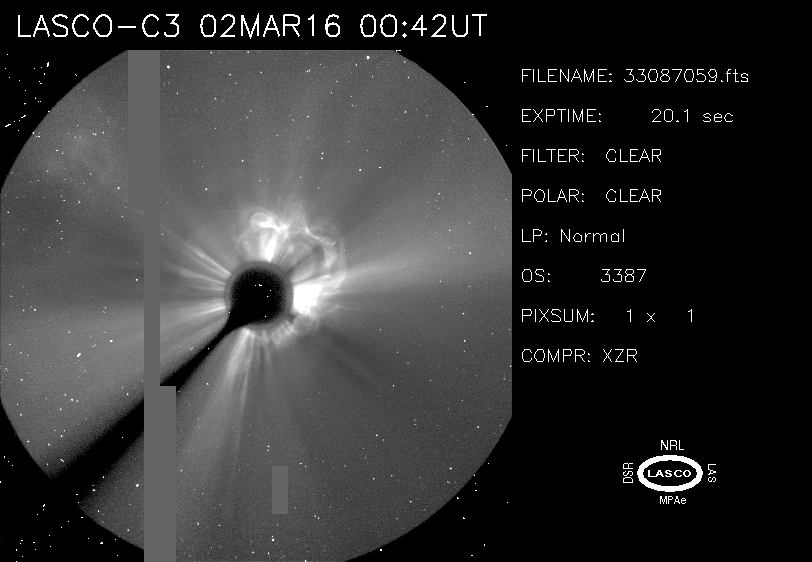
A 12-hour M2-class solar flare erupted apparently near sunspot 9866 at 2315 UT on March 15. Such long-lasting flares are usually sparked by magnetic eruptions that also hurl coronal mass ejections (CMEs) into space -- and this was no exception. Preliminary SOHO coronagraph images (right) reveal a full-halo CME heading our way.
Stay tuned to SpaceWeather.com for more information.
PHOTOGENIC COMET:
Look low over the western horizon after sunset and you can spot Comet Ikeya-Zhang. The blue-tinged fuzzball is glowing like a 3.8th magnitude star in the constellation Pisces -- easy enough to see with the unaided eye from places with dark skies. The comet's tail, stretching 5 or more degrees, has been particularly photogenic -- witness the image below.
It appears I caught a disruption event in the tail of comet Ikeya-Zhang on the evening of 3/11/02. I re-imaged the comet on 3/12/02 and the tail had re-stabilized.
Each frame in the mozaic is 10x15second exposures using an ST-237A CCD camera on a C8 with Fastar at F1.95.
Image Credit: Gilbert Jones.
Says astronomer Clay Sherrod: "The comet's tail will soon fade against twilight skies as the comet approaches the Sun." Indeed, the entire comet will disappear for a while around March 18th when it has a close encounter with our star. After that Ikeya-Zhang will become a pre-dawn object best seen in April.
[finder chart] [orbit] [interactive orbit] [ephemeris] [gallery]
AURORA WATCH:
There remains a slim chance that debris from Thursday's M5-class solar flare will buffet Earth's magnetic field and trigger mild auroras after local sunset on Saturday. Prospects for Northern Lights will improve on Sunday and Monday when a full-halo coronal mass ejection (described above) sweeps past our planet.
- ><><><>< - ><><>< - ><>< - ><><>< - ><><><>< -
Current Conditions (updated: Today at 1845 UT)
Solar Wind velocity: 295.2 km/s
Density: 2.1 protons/cc.
X-ray Solar Flares (Updated: Today at 1840 UT)
6-hr max: C2 1455 UT Mar 16
24-hr: M2 2315 UT Mar 15
Radio Meteor Rate (Updated: 15 March 2002)
24 hr max: 13 per hr
(Listen to the Meteor Radar!)
Sunspot Count (updated: 16 March 2002)
Sunspot Number: 134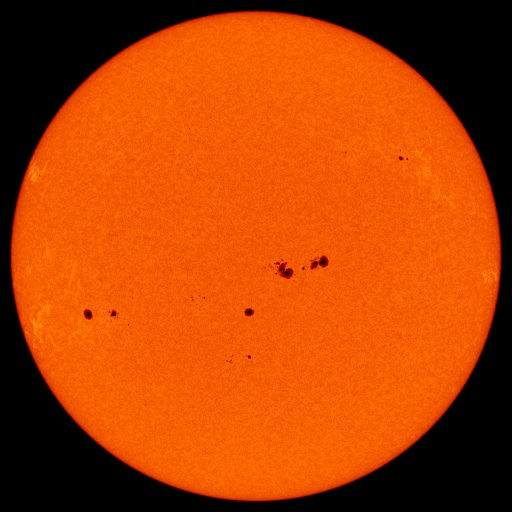

- ><><><>< - ><><>< - ><>< - ><><>< - ><><><>< -
Auroral Activity Extrapolated from NOAA POES . . .
Instruments on board the NOAA Polar-orbiting Operational Environmental Satellite (POES) continually monitor the power flux carried by the protons and electrons that produce aurora in the atmosphere. SEC has developed a technique that uses the power flux observations obtained during a single pass of the satellite over a polar region (which takes about 25 minutes) to estimate the total power deposited in an entire polar region by these auroral particles. The power input estimate is converted to an auroral activity index that ranges from 1 to 10.
(More from NOAA POES)
Subscribe to Space Weather News!
Dan
Weather for 16 Mar 2002 -- Long Flare & Photogenic Comet!