
<
Weather for 22 April, 2002 -- A Solar Blast!
X-FLARE:
Twisted magnetic fields above
sunspot 9906 erupted at ~0100 UT on April 21st. The explosion sparked a powerful X1-class solar flare and hurled a coronal mass ejection (gif movie) into space. Although the CME was not squarely Earth-directed (because the source of the explosion was near the Sun's western limb), it will nevertheless deliver a glancing blow to our planet's magnetosphere on April 22nd or 23rd. Sky watchers should remain alert for auroras tonight.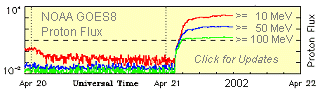
Above:The flux of high-energy protons streaming past Earth soared 10,000-fold after Sunday's solar blast.
As a result of Sunday's blast, an S2-class radiation storm is in Progress. Such storms can affect radio propagation through Earth's atmosphere and fog cameras on spacecraft, but they pose no threat to people on Earth's surface or to astronauts on board the International Space Station.
Can you spot the comet?
Image Credit: Astronomy Picture of the Day -- April 22, 2002.
AURORAS:
A coronal mass ejection (CME) that left the Sun on April 17th swept past our planet on Friday, April 19th, at approximately 0830 UT (1:30 a.m. PDT). The impact ignited a geomagnetic storm that persisted for more than 24 hours. Friday-night sky watchers across Canada and parts of the United States spotted beautiful Northern Lights.
April 19, 2002 -- near San Diego, California, USA
"Subtle? You bet! So subtle, in fact, that none of us could actually see these auroras with the unaided eye. But the indicators suggested that they would be there and, indeed, this digital camera image shows [the Northern Lights over southern California]."
Photo details: 15-minute exposure on Fuji Provia 400F film at f/4 .
Image Credit: Dennis Mammana.
METEOR SHOWER:
The annual Lyrid meteor shower is peaking. Northern sky watchers who rose a few hours before local dawn on Monday, April 22nd, likely spotted 10 or so meteors per hour shooting from the vicinity of the bright star Vega in the constellation Lyra. This is a modest shower, but it occasionally produces lovely shooting stars.
[more]
FADING COMET:
Although Comet Ikeya-Zhang is approaching our planet, it is also fading as it recedes from the Sun. Astronomer Clay Sherrod reports on April 18 that "Ikeya-Zhang is just visible to the naked eye and has dimmed almost one-half magnitude since April 12." Nevertheless, there's still time to see the comet before it vanishes. Get up before dawn any morning this week and look north between the constellations Cassiopeia and Cygnus; the comet is a fuzzy blob about as bright as a 4th magnitude star.
[gallery] [finder chart] [orbit] [interactive orbit] [ephemeris]
- ><><><>< - ><><>< - ><>< - ><><>< - ><><><>< -
Current Conditions (updated: Today at 1503 UT)
Solar Wind velocity: 414 km/s
Density: 6.8 protons/cc.
X-ray Solar Flares (Updated: Today at 2135 UT)
6-hr max: C1 2030 UT Apr 22
24-hr: C4 0015 UT Apr 22
Radio Meteor Rate (Updated: 22 Apr 2002)
24 hr max: 28 per hr
(Listen to the Meteor Radar!)
Sunspot Count (updated: 21 Apr 2002)
Sunspot Number: 160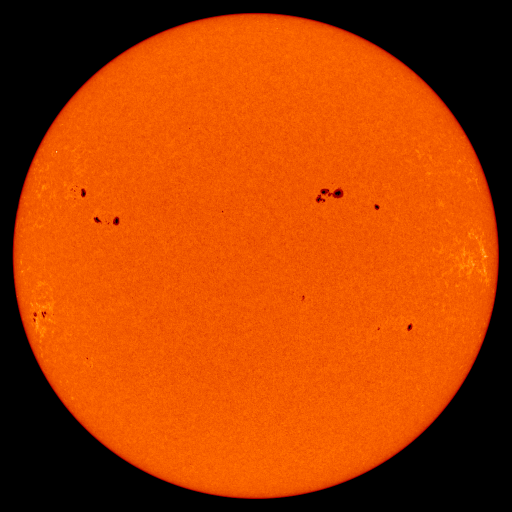

- ><><><>< - ><><>< - ><>< - ><><>< - ><><><>< -
Hot Shots from SOHO . . .
Now Showing: Comet SOHO-422
The comet SOHO-422 was first reported on Friday, April 12, by XingMing Zhou of China, who discovered the comet while watching SOHO real-time images on the internet. The comet is new, not belonging to any known group of comets. The comet was first visible late in the day on Thursday, April 11, and could be followed in LASCO C3 images until Friday, April 19, attracting some media attention along the way (see lenks sectin below). It entered the FOV at the bottom edge, almost directly under the Sun, moving upwards, first to the left. It then moved back towards the right, exiting from the LASCO C3 field of view at the top edge, to the right of the Sun.
It reached perihelion on April 17 at about 6:30 UT, at a distance of 17.7 solar radii. At this time, the apparent distance in LASCO was about 13 solar radii. The comet is officially designated as C/2002 G3 (SOHO) in MPEC 2002 G51.
(Source)
Subscribe to Space Weather News!
Dan
Weather for 22 April, 2002 -- Solar Blast!