
<
Weather for August 3, 2002 -- Aurora Surprise!
AURORA SURPRISE:
An unexpected geomagnetic storm began on Thursday, August 1st, as night fell across North America. Sky watchers who happened to be outdoors spotted vivid auroras over both the United States and Canada.
[gallery]
Aug. 1-2: This photo is looking to the southeast. You can see the lights of Bismarck, ND to the south. "It was an amazing show. I was able to view auroras to the north, and to the south."
Image Credit: L. Anderson.
LOOK AT THAT ASTEROID:
There's no danger of a collision. Even so, a big space rock will soon come so close to Earth that sky watchers can see it through binoculars. Read the full story from Science@NASA.
SPACESHIP SIGHTINGS:
The International Space Station (ISS) is now making a series of bright passes over the United States and Canada. Read the full story from Science@NASA and find out how to see it from your own back yard.
Above: A 16-inch telescope at the Munich Public Star Observatory was used to capture this image of the ISS on July 27, 2002. The figure at the bottom is a computer-generated graphic, added for comparison.
Image Credit: Josef Huber and Tobias Lindeman -- Munich Public Star Observatory.
- ><><><>< - ><><>< - ><>< - ><><>< - ><><><>< -
Current Conditions (updated: Today at 2016 UT)
Solar Wind velocity: 408.3 km/s
Density: 4.2 protons/cc.
X-ray Solar Flares (Updated: Today at 2015 UT)
6-hr max: M9 1905 UT Aug 03
24-hr: M9 1905 UT Aug 03
Sunspot Count (updated: 11 May 2002)
Sunspot Number: 96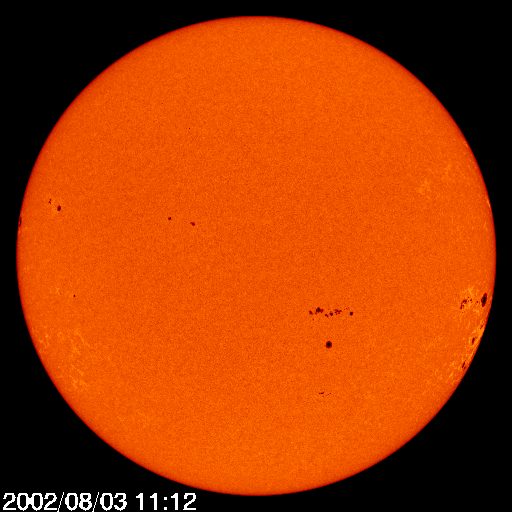

- ><><><>< - ><><>< - ><>< - ><><>< - ><><><>< -
The Recession of the Moon
and the Age of the Earth-Moon System
by Tim Thompson
One of the common arguments made in support of young-Earth creationism is that the dynamic age of the Earth-moon system (as determined by the physics of the Earth-moon tidal interaction) is too young to support a multi-billion year age for the system. In this article I will (a) review the basic physics of gravity and tides, (b) review the history of theoretical models for Earth-moon tides, (c) review the paleontological evidence relevant to the history of the Earth-moon system, and (d) demonstrate that the combination of theory and observation refute the young-Earth creationist arguments, with reference to specific young-Earth arguments and their specific failures. This is intended as a review for readers not versed in physics and math, so the arguments are presented as non-technically as possible. There are references to more technical work, for those who are interested in following up any of the arguments presented here as accepted assertions.
Five Hours After Impact, based on computer modeling by A. Cameron, W. Benz, J. Melosh, and others.
Image Credit: William K. Hartmann.
While this article is intended as a refutation of yet another ill conceived young-Earth argument, the introductory reviews do not refer to creationism at all. Therefore, the article should work just as well as an introduction to the physics of the evolution of the Earth-moon system, even for those readers not interested in the issue of creation vs. evolution.
(Source)
Subscribe to Space Weather News!
Dan
Weather for August 3, 2002 -- Aurora Surprise!