
With each factor of 10 improvement of visual resolution of Mars has
come revolutionary changes in our understanding of the role of liquid
water on Mars. What revolutionary improvement over the discovery of
possibly currently forming gullies by MGS might we predict for MRO?
I suggest small ponds will be observed by MRO on Mars, oases if you
will. These will be analogous to Don Juan pond in Antarctica. Note that
Don Juan pond is able to remain frozen year round down to perhaps -45 C
temperatures because of abundant salts. The MER rovers suggest such
salts are also abundant on Mars.
I believe that such ponds have been seen by MGS, but they have been
hard to prove at the resolution of MGS. I'm suggesting they will be
proven by MRO. Note that the Malin-Edgett gullies were not discovered
by Viking orbiter imaging, but the fact that THEMIS on Mars Odyssey has
been able to detect them at similar resolution to the Viking orbiter
resolution suggests they were visible by Viking, just not provably so.
A *possible* example of ponding seen by MGS:
Mars Orbiter Camera (MOC) High Resolution Images:
Seepage and Ponding within a Southern Hemisphere Crater
http://www.msss.com/mars_images/moc/5_27_98_agu_release/
My guess for where they will be found is at near equatorial areas that
are known to have low lying fogs or clouds:
Clouds in Noctis Labyrinthis on Mars.
http://www.photovault.com/Link/Universe/Planets/Mars/UPMVolume01/UPMV01P02_06NoctisLabyr.html
Note that the frost deposition on the MER Opportunity rover was
observed in connection with clouds over the site. The fogs/clouds seen
over Noctis Labyrinthis are much denser and closer to the surface.
Indeed they look more like cumulus clouds than thin cirrus clouds,
which is why I'm suggesting visible surface ponds with better
resolution imaging. To be precise, I'm predicting such ponds will be
seen during the period such low, dense fogs are seen over these near
equatorial locations.
Here is another image of the western end of Valles Marineris showing
dense low lying fogs/clouds:
taken from:
Adsorption water-driven processes on Mars.
D. Möhlmann, DLR-PF, Berlin.
FIRST MARS EXPRESS SCIENCE CONFERENCE. 21-25 February 2005, ESA/ESTEC
http://sci.esa.int/science-e/www/object/doc.cfm?fobjectid=36779
Another possible location for ponding is in Newton crater:
Evidence for Recent Liquid Water on Mars:
Channeled Aprons in a Small Crater within Newton Crater.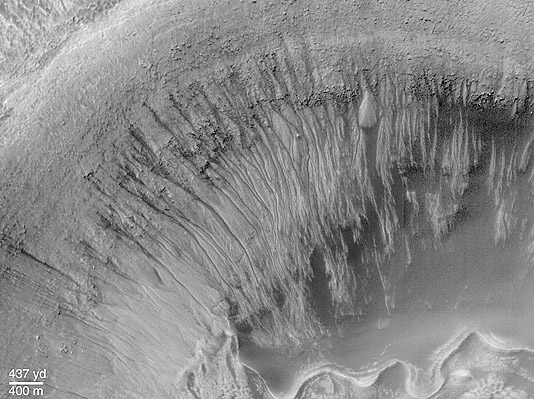
http://www.msss.com/mars_images/moc/june2000/newton/
At 41 S latitude, this is not a near equatorial site, but there are
abundant low lying fogs in the image and the connection with gullies is
suggestive.
Another possible site may be the Hellas crater basin since this also
presents frequent low lying fogs or clouds.
Some MGS images of Hellas are here:
MOC Narrow-Angle Image Gallery: Mars Chart 28: Hellas
http://www.msss.com/moc_gallery/m07_m12/mc28.html
Bob Clark
What will Mars Reconnaissance Orbiter find?