
Thanks for the link to the images of Noctis Labyrinthus, part of the Valles Marineris system. Noctis Labyrinthus frequently shows dense low lying clouds/fogs that give the appearance of precipitation carrying clouds on Earth:
Noctis clouds.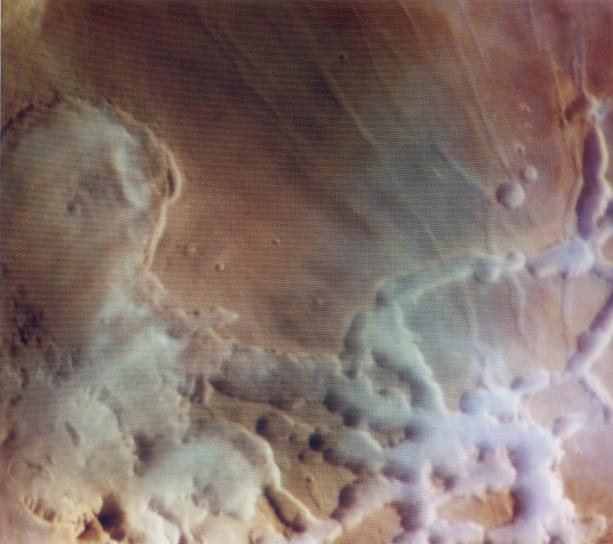
Here's another great image showing dense clouds/fogs in Valles Marineris somewhat further west of Noctis:
taken from this ESA report:
Adsorption water driven processes on Mars.
D. Möhlmann
FIRST MARS EXPRESS SCIENCE CONFERENCE
21-25 February 2005, ESA/ESTEC
http://sci.esa.int/science-e/www/object/doc.cfm?fobjectid=36779
The author reaches these conclusions:
"Adsorption water in the upper martian surface is an actual challenge to martian surface chemistry and possibly also to exobiology:
* Adsorption water makes possible and/or supports a martian surface chemistry, also at present: These processes are energetically driven by photons (UV). Current martian surface chemistry is mainly (non-thermal) photo-chemistry.
* Existing iron oxides (as haematite), UV and adsorption water are a cause for the production of oxidizing OH-radicals, which are expected to contribute to the oxidation of organics (Methane, carbonaceous meteorites).
* Adsorption water mobilizes acids (as sulfuric acid), which can modify earlier formed carbonates (surface cover by sulfates, e.g.).
* Adsorption water covered catalytic surfaces of minerals are expected to be essential agents in non-thermal photo-chemical processes. Photon driven non-thermal redox-processes on catalytic surfaces might together with atmospheric CO2 cause a non-biogenic production of organics (?). Related experiments are in preparation.
* Adsorption water deposits also on the surfaces (cell walls) of microbes etc. There, it can be a source of water for the microbial metabolism. Physico-chemical processes can be supported by adsorption water. To study the relevance of adsorption water for life-processes is a current challenge to exobiology. Related experiments are in preparation."
This Mars Express image of Valles Marineris with the dense fogs was taken May 25, 2004 in mid southern Autumn on Mars at a time approaching Mars aphelion. Southern Autumn is coming up now on Mars. Equatorial clouds are known to be seasonal on Mars, frequently occurring near aphelion. It would be interesting to find out if higher resolution imaging by Mars Reconnaissance Orbiter also detects these dense low lying clouds/fogs.
Bob Clark
Space/Science » in reply to Mars Express on the Labyrinth of the Night !
re: Mars Express on the Labyrinth of the Night !