"The Maunder Minimum is the name given to the period roughly from 1645 to 1715, when sunspots became exceedingly rare, as noted by solar observers of the time. It is named after the solar astronomer Edward W. Maunder (1851–1928) who discovered the dearth of sunspots during that period by studying records from those years. During one 30-year period within the Maunder Minimum, for example, astronomers observed only about 50 sunspots, as opposed to a more typical 40,000–50,000 spots."
...
The Maunder Minimum coincided with the middle — and coldest part — of the Little Ice Age"
http://en.wikipedia.org/wiki/Maunder_minimum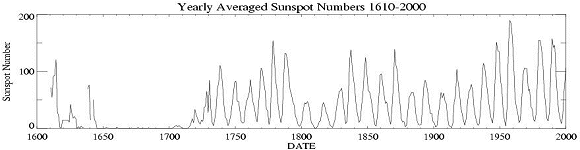
So, there been less sunspot activity lately, but doesn't mean that 2008 and years coming couldn't have as much as the high levels we have seen throughout 20th Century.
And as your link says: "Over the whole sunspot cycle, at most, this would raise the temperature of the Earth on average by 0.2 degrees Celsius"
Well, taking Bad Astronomer's number, .2 C is a significant amount. If higher than normal just adds .2 C and lower than than normal [a Maunder Minimum] subtracts some amount. One or two years of high sun spot activity probably wouldn't cause .2 C increase, but decades of higher or decades none of few causing such change then it's a major factor.
Space/Science » in reply to Um, yeah. No.
re: Um, yeah. No.