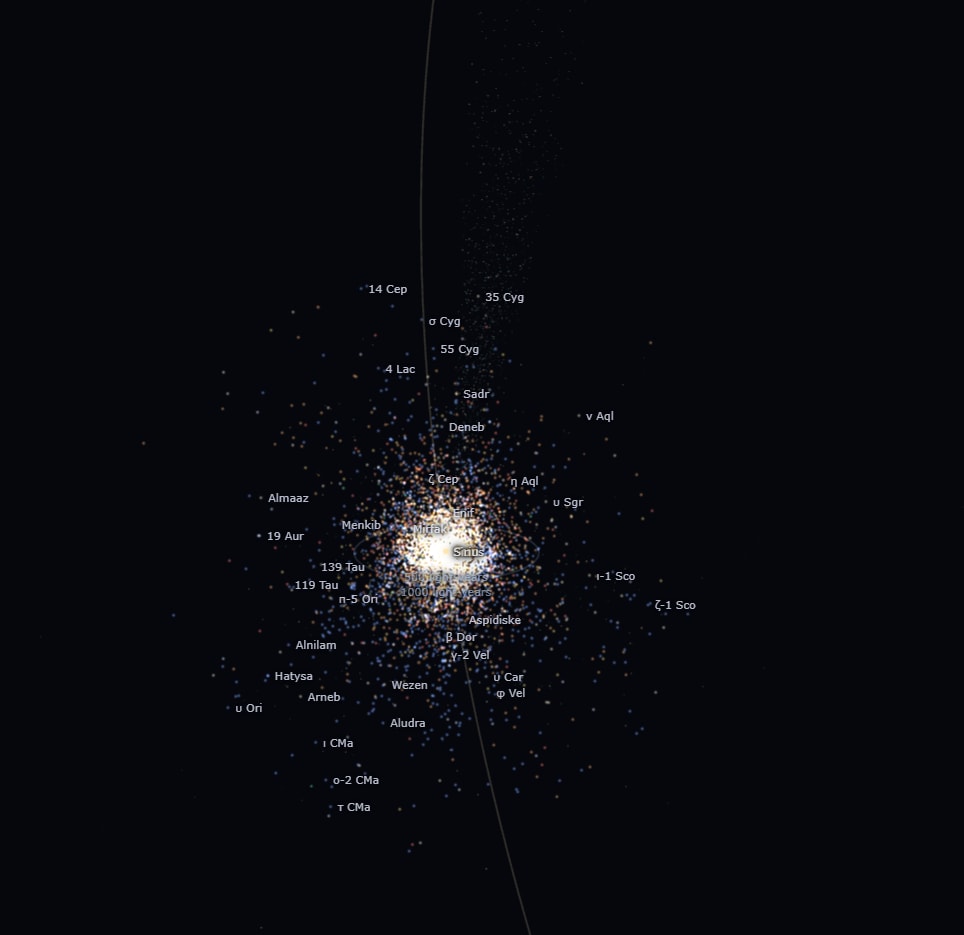
Interesting thing I learned from the orrery
You can see that detected exoplanets are all fairly local EXCEPT a cone extending thousands of light years in one direction- all of them Kepler detections- The reason for this:
Kepler stared at one patch of sky. For its whole main mission (2009–2013) it watched a single field of about 115 square degrees, roughly 0.25% of the sky, in Cygnus and Lyra. It monitored about 150,000 stars there continuously for four years. That's why the cone points past Deneb and Sadr in your screenshot.
Why one patch: to catch an Earth-like planet you need to see it cross its star's face (a "transit") at least three times. For a one-year orbit that means watching the same stars without a break for years. Kepler's field was chosen well away from the ecliptic, so the Sun never got in the way at any time of year. It was also rich in stars, being just off the plane of the Milky Way, looking roughly along our own spiral arm, though slightly above the plane to avoid overcrowding.
Why it reaches thousands of light-years: the transit method works on faint stars. Kepler measured stars down to about magnitude 16, so most of its planet hosts are 1,000–3,000 ly away, far beyond the stars you can see by eye. The field is about 10° across, so at 3,000 ly it's a column several hundred light-years wide, which is the narrow cone you see.
Why it dominates the view: Kepler's main mission confirmed more than 2,700 planets, roughly half of all known exoplanets. Almost all of them sit in that one column.