
<
Weather for 1 April 2002 -- COMET CONJUNCTION!
SOLAR ACTIVITY:
Sunspot 9885 has grown impressively in recent days. Its twisted magnetic field -- poised like a stretched rubber band ready to snap back -- could unleash powerful X-class solar flares at any time. Such eruptions this week would likely be Earth-directed as the spot crosses the face of the Sun.
Above: This SOHO animation spanning March 27th through 31st shows sunspot 9885 growing into a large active region.
Image Credit: NASA/ESA.
AURORA WATCH: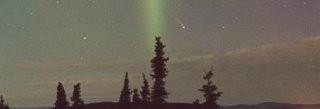
Above: On Mar. 24th, green-colored Northern Lights appeared over Alaska with Comet Ikeya-Zhang in the background.
Image Credit: Mike O'Leary.
Earth is inside a gusty, high-speed solar wind stream flowing from a coronal hole on the Sun. Sky watchers at high latitudes -- e.g., northern Europe, Canada and the northern tier of US states -- should remain alert for auroras this weekend.
March 23, 2002: Near the entrance to Denali National Park, Alaska, USA.
Photo details: Canon G-2 digital camera; exposure time 5-15 seconds at f/2.8
Image Credit: Mike O'Leary.
[gallery]
ANDROMEDA COMET:
Northern sky
watchers are in for a treat just after sunset
on April 4th. As the sky fades to black,
Comet Ikeya-Zhang and the great
Andromeda Galaxy will meet about 10
degrees above the western horizon. Less than half a degree (the
width of one full Moon) will separate the pair. Dark skies and an
unobstructed view of the horizon are essential for observers who
wish to watch the encounter. The comet and the galaxy both will
be dimly visible to the unaided eye -- even so, binoculars are
recommended.
[Finder charts: April 4th; April 3rd (detail); April 4th (detail); April 5th (detail)] [orbit] [interactive orbit] [ephemeris] [gallery]
- ><><><>< - ><><>< - ><>< - ><><>< - ><><><>< -
Current Conditions (updated: Today at 1226 UT)
Solar Wind velocity: 783.5 km/s
Density: 1.4 protons/cc.
X-ray Solar Flares (Updated: Today at 1220 UT)
6-hr max: C1 0810 UT Apr 01
24-hr: C5 1120 UT Mar 31
Radio Meteor Rate (Updated: 28 Mar 2002)
24 hr max: 29 per hr
(Listen to the Meteor Radar!)
Sunspot Count (updated: 31 March 2002)
Sunspot Number: 133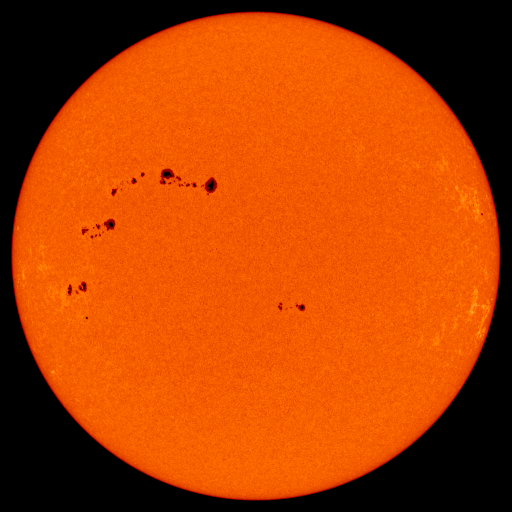

- ><><><>< - ><><>< - ><>< - ><><>< - ><><><>< -
Methane Earth . . .
posted: 12 February 2002
Explanation: Can you help in reducing this blanket of methane gas that is warming up our Earth? Recent evidence holds that methane (CH4) is second only to carbon dioxide (CO2) in creating a warming greenhouse effect but is easier to control. Atmospheric methane has doubled over the past 200 years, and its smothering potency is over 20 times that of CO2. Methane may even be responsible for a sudden warming of the Earth by seven degrees Celsius about 55 million years ago. As most methane is produced biologically, the gas is sometimes associated with bathroom humor. The largest abundance released by the US, however, is created when anaerobic bacteria break down carbon-based garbage in landfills. Therefore, a more effective way to help our planet than trying to restrict your own methane emissions would be to encourage efficient landfill gas management.
Image Credit: GISS, NASA.
[Source: Astronomy Picture of the Day Archive]
Subscribe to Space Weather News!
Dan
Weather for 1 April 2002 -- COMET CONJUNCTION!