
<
Weather for Friday, July 19, 2002 -- ARORA WATCH THIS WEEKEND!
TWO BIG SUNSPOTS:
Sunspot 30 has decayed a little, but it remains impressive, stretching fifteen Earth-diameters from end to end. Meanwhile, another sunspot (active region 36) has grown nearly as large. You can see the pair--but never stare directly at the Sun. Use safe solar projection methods. Both spots pose a threat for powerful X-class eruptions.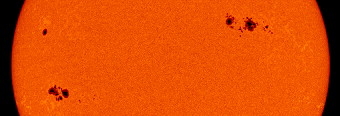
Above: The Solar and Heliospheric Observatory captured this image of sunspot 30 (upper right) and sunspot 36 (lower left) on July 18th.
AURORA WARNING:
Twisted magnetic fields above sunspot 30 erupted on Thursday, July 18th. The explosion (at 0745 UT) sparked an X2-class solar flare and hurled a faint coronal mass ejection toward Earth. Sky watchers should be alert for possible auroras after nightfall on Friday and Saturday.
CLOSE ENCOUNTER:
Jupiter is remarkably near the Sun today--a close encounter that would be fun to watch if not for the Sun's blinding glare. The orbiting Solar and Heliospheric Observatory, however, can safely observe the whole thing. SOHO's coronagraph blocks the Sun's light with an opaque disk, revealing stars, planets and the Sun's faint corona. Yesterday, SOHO recorded this lovely movie of Jupiter and two coronal mass ejections. (Note: the horizontal line through Jupiter is a digital imaging artifact, not a planetary ring.)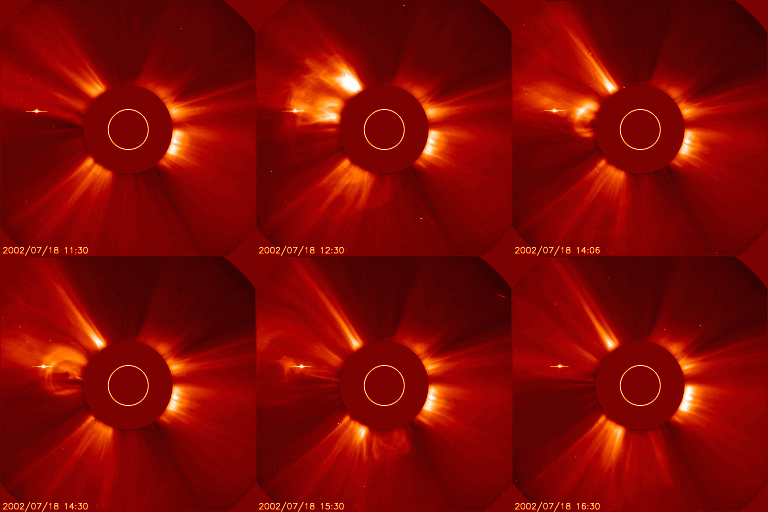
WEAK IMPACT:
A coronal mass ejection that left the Sun on Monday, July 15th, swept past our planet Wednesday, July 17th. The impact triggered some geomagnetic activity--but not a full-fledged storm.
- ><><><>< - ><><>< - ><>< - ><><>< - ><><><>< -
Current Conditions (updated: Today at 1435 UT)
Solar Wind velocity: 458.1 km/s
Density: 1.9 protons/cc.
X-ray Solar Flares (Updated: Today at 1430 UT)
6-hr max: C1 1020 UT Jul 19
24-hr: C7 2315 UT Jul 18
Sunspot Count (updated: 18 July 2002)
Sunspot Number: 166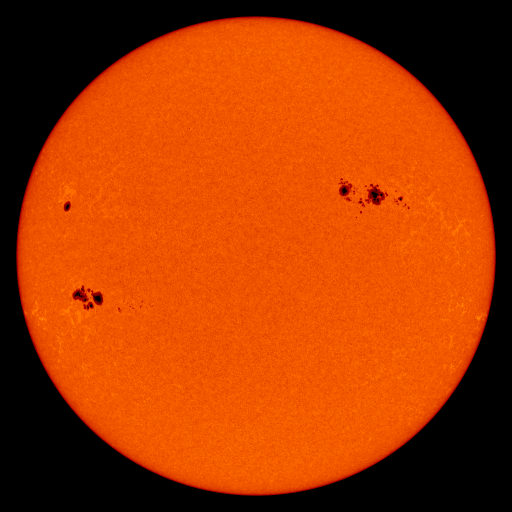

- ><><><>< - ><><>< - ><>< - ><><>< - ><><><>< -
NASA Human Spaceflight . . .
high resolution (4.0 M) image available.
S69-39962 (16 JULY 1969)
The huge, 363-foot tall Apollo 11 Spacecraft 107/Lunar Module 5/Saturn 506) space vehicle is launched from Pad A, Launch Complex 39, Kennedy Space Center (KSC), at 9:32 a.m. (EDT), July 16, 1969. Aboard the Apollo 11 spacecraft were astronauts Neil A. Armstrong, commander; Michael Collins, command module pilot; and Edwin E. Aldrin, Jr., lunar module pilot. Apollo 11 is the United States' first lunar landing mission. This view of the liftoff was taken by a camera mounted on the mobile launch tower. While astronauts Armstrong and Aldrin descend in the Lunar Module (LM) "Eagle" to explore the Sea of Tranquility region of the Moon, astronaut Collins will remain with the Command and Service Modules (CSM) "Columbia" in lunar-orbit.
(Source)
Subscribe to Space Weather News!
Dan
Weather for Friday, July 19, 2002 -- ARORA WATCH THIS WEEKEND!