
Another example of dense low lying clouds in a near equatorial site, this over Noctis Labyrinthus from a Viking orbiter image: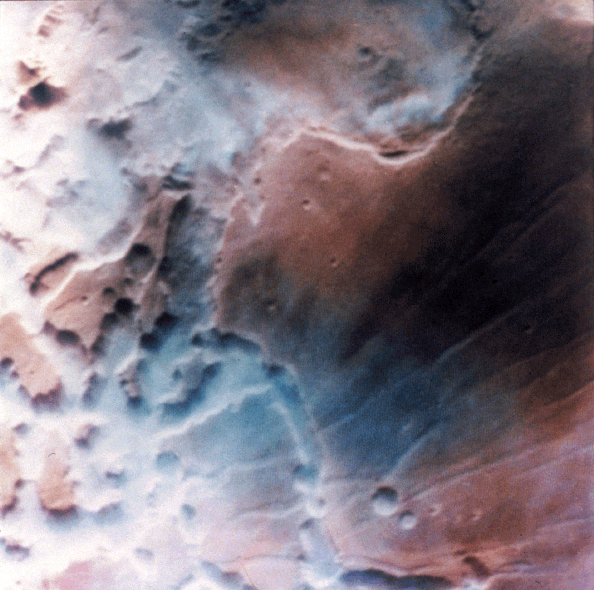
From:
Martian Clouds.
http://www.solarviews.com/eng/marscld.htm
See also the descriptions here:
-------------------------------------------
NASA SP-441: VIKING ORBITER VIEWS OF MARS
--------------------------------------------
- THE ATMOSPHERE -
"Early Morning Clouds in the Tharsis Montes and Valles Marineris
Region. Ascraeus Mons and Pavonis Mons are prominently displayed in
this mosaic, and dense cloud blankets cling to their northern slopes.
High cirrus clouds lie to the west of Tharsis, and waves are visible
in the clouds surrounding the peaks. Bands of clouds appearing to
have a cellular structure extend north from the canyon, and the areas
within and immediately surrounding the chasm exhibit water-ice fogs.
[211-5049; 5°S, 105°W]"
"Early Morning Surface Fog. The presence of morning fogs in some
crater and channel bottoms is a Viking discovery with possible
implications for the future biological exploration of Mars. These
early morning views of the Memnonia region were taken one-half hour
apart using a violet filter to enhance the contrast of the
condensates. The areas marked by arrows are noticeably brighter in
the later picture. The fogs indicate specific spots where water is
exchanged, probably on a daily cycle, between the surface and the
atmosphere. The surface and lower air layers in this region become
unusually cold at night because of the thermal properties of the
surface. When the surface warms in the morning, it seems that a small
amount of water vapor-estimated to be about one-millionth of a meter
thick if liquefied is driven off; this vapor recondenses in the
atmosphere, which warms more slowly, to form a ground fog of ice
particles. [P17487; 13°S,147° W]"
"Early Morning Clouds in Noctis Labyrinthus. Condensate clouds are
seen here in early morning in the canyons of Labyrinthus Noctis,
which lies at the western end of the equatorial Valles Marineris
system. This picture, which covers about 90 000 km2, was made by
combining three frames of the same field taken through violet, green,
and red filters. Although these clouds lie mainly down inside the
canyons, they evidently extend above the walls and spill over some of
the surrounding plateau. Like most condensate clouds in the Martian
troposphere, they are believed to be composed of water-ice crystals.
[P18114, 9°S, 95°W]"
http://history.nasa.gov/SP-441/ch12.htm
Such sites would be ideal place for a future lander, including MSL, particularly during the seasonal period where such low lying clouds/fogs are known to be present.
Bob Clark
Space/Science » in reply to re: Phoenix detects falling snow
H2O snow is a widespread occurence on Mars.