
GCN Circular 46301
GRB 261113A: GECAM-B observation
From: Xinghao Luo at IHEP
Issued: 2026-11-16 07:23 UTC
Type: GRB, Gamma-ray Transient
Xing-Hao Luo, Chen-Wei Wang, Ren-Yang Zhao, Shao-Lin Xiong (IHEP) report on behalf of GECAM team:
GECAM-B was triggered in-flight by GRB 261113A, at 2026-11-13T14:31:02.050 UTC (denoted as T0), which is also detected by SVOM/ECLAIRs (A. Saccardi et.al., GCN#46244), Konus-Wind (D. Frederiks et.al., GCN#46268) and SVOM/GRM (Xue-Yuan Zao et.al., GCN#46287).
According to the GECAM-B light curves in about 70-6000 keV, this burst mainly consists of multiple pulses with a duration (T90) of 7.4 +0.6/-0.4 s.
The GECAM-B light curve can be found here: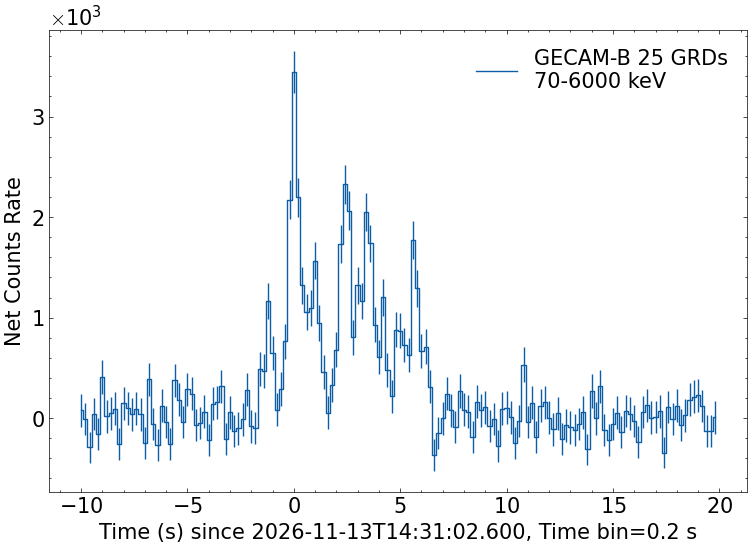
In addition, the position of this burst, as determined by SVOM/GWAC-60 (RA=346.32051 deg, DEC=5.17192 deg, with an uncertainty of 0.5 arcsec, S.J. Yin et.al., GCN#46250).
With this localization, the time-averaged spectrum from T0-1.7 to T0+6.5 s is best fitted by a power law function. The power law index is -2.55 +0.19/-0.20 and the event fluence (10-1000keV) in this time interval is (1.07 +0.30/-0.20)E-05 erg/cm^2.
Gravitational wave high-energy Electromagnetic Counterpart All-sky Monitor (GECAM) mission originally consists of two micro-satellites (GECAM-A and GECAM-B) launched in Dec. 2020. As the third member of GECAM constellation, GECAM-C was launched onboard SATech-01 experimental satellite in July 2022. GECAM mission is funded by the Chinese Academy of Sciences (CAS).
Every one of the gamma-ray bursts GCN reports is posted here.
Relayed automatically from NASA's General Coordinates Network.
Transient Alerts » in reply to GRB 261113A — GRB, X-ray Transient
In plain words Notable
On 13 November 2026 the SVOM satellite (a China-France gamma-ray observatory) detected a bright, roughly 7-second flash of gamma rays in the constellation region near RA 346.3, Dec +5.1. Within about two minutes, telescopes in several countries found a fading optical afterglow at the same spot, which peaked at about magnitude 11 within ten seconds of the burst, visible only in a telescope or camera. Spectra from the VLT in Chile and the GTC in Spain show it lies at redshift 3.58, meaning the light left roughly 12 billion years ago. The pattern of flashes and the energy output match the usual long gamma-ray bursts, which come from the collapse of a massive star. One team suggests a bend in the fading light 3 to 4 hours after the burst, a sign the explosion was a narrow jet pointed our way; this is tentative.
How unusual is it? Most gamma-ray bursts have no measured distance, but this one has a secure redshift of 3.58 and an afterglow caught within seconds, peaking at about magnitude 11, which is unusually bright and early. The energy release itself (about 10^53 erg) is typical of long bursts, so it is not exceptional.
Written by an AI model (claude-sonnet-5-5) from the official reports in this thread, and rewritten as new reports arrived (version 7); last updated . It may contain mistakes: the reports themselves are the authority.
GRB 261113A: GECAM-B observation
The whole thread (34 posts)
- GRB 261113A — GRB, X-ray Transient
- GRB 261113A: Glowbug gamma-ray detection
- GRB 261113A : MITSuME Akeno optical afterglow detection
- GRB 261113A: GECAM-A observation
- GRB 261113A: GECAM-B observation
- GRB 261113A : GRANDMA and KNC optical detections and upper limits
- Updated explainer: what the latest reports add (AI-written)
- GRB 261113A: R-band observations with the 1.3m DFOT
- GRB 261113A: SVOM/GRM observation
- Optical Observations of GRB 261113A
- GRB 261113A: AZT-20 Assy-Turgen optical observations
- Explainer: what this is and why it matters (AI-written)
- GRB 261113A: SVOM/GWAC bright optical counterpart
- GRB 261113A: Ondrejov D50 optical observations
- GRB 261113A: SVOM/ECLAIRs refined analysis
- Konus-Wind detection of GRB 261113A
- GRB 261113A: Liverpool Telescope observations
- GRB 261113A: SVOM/COLIBRÍ (FM-GFT) optical observations
- GRB 261113A: 10.4m GTC spectroscopic confirmation of z = 3.58
- GRB 261113A: Mondy and AbAO optical observations
- GRB 261113A: NUTTELA-TAO early optical observations
- GRB 261113A: VLT/X-shooter spectroscopic redshift z = 3.580
- GRB 261113A: TNG NIR afterglow detection
- GRB 261113A: NOT optical observations
- GRB 261113A: OHP/T193 optical detections of the afterglow
- GRB 261113A: GROWTH-India Telescope optical observations
- GRB 261113A: SVOM/VT optical decay slope
- GRB 261113A: Optical detection with 60cm Panzhihua Telescope
- GRB 261113A: SVOM/VT optical observation from VHF data
- GRB 261113A: Xinglong 2.16m optical afterglow detection
- GRB 261113A : SVOM/GWAC-F60 optical afterglow detection
- GRB 261113A: GMG Optical Observation
- GRB 261113A: JinShan optical afterglow detection
- GRB 261113A: K-band infrared counterpart candidate by the SYSU 80cm infrared telescope