
The most common bioluminescent phytoplankton is Noctiluca sp., which is common all over the world's oceans, but there are no doubt other species. In Puerto Rico there is even a Phosphorescent Bay--its a big tourist attraction.
Red Tide (Gymnodium) does not glow in the dark, but in high concentrations you can actually see an oily reddish scum floating on the surface of still water. There is nothing to prevent you from having simultaneous blooms of N. AND G., but as a rule they are not connected.
Phosphorescence is often seen in perfectly healthy water, even far out at sea. We used to go to the fantail on our ship, especially when we were steaming dark on night patrols (with our stern NAV light turned off) and watch the screws churn the sea into a cauldron of blue green fire that stretched behind us in our wake for as far as we could see.
Red Tide is rare in Florida, and usually localized in a small area (unlike the current outburst). Noctiluca's blue glow is common but rarely noticed in FL because there is so much development at the beach that the lights drown it out. You Californians have managed to keep artificial light away from your wild coastlines! But night sailors and fishermen here are very familiar with it. In a small boat you can see the fish darting around, getting out of your way, like ghostly torpedoes, and in your wake there is an unearthly blue green highway in the sea stretching out behind you. If water splashes on you, the dark-adapted eye can see the sparkle of the individual organisms blinking on and off on your skin and clothes, dripping off the sail and ghostly outlining sheets and halyards. The water sloshing in the bilge is a witches' brew glowing blue-green like something from the Ancient Mariner. If there is a chop, every whitecap flashes as the wave peaks, where the foam should be. A bottle filled with sea water and shaken briefly glows bright enough to read by.
Your photo is perfectly color-balanced! Its hard to get that right at low light levels. That's exactly what you see. Thanks for posting this, Robert. It brought back a flood of beautiful memories, things I doubt I'll ever see again. And its also given me yet another flash of bitter hatred for what these bastards are doing to my planet.
Noctiluca scintillans (Twinkling night light)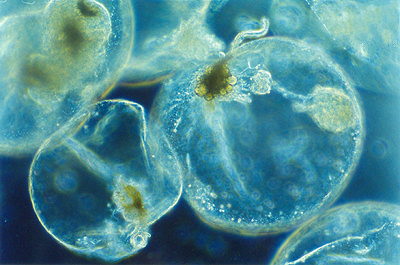
Space/Science » in reply to As goes California...
NOT the same thing!