
GCN Circular 45807
GRB 260930B: SVOM/GRM observation
From: unknown
Issued: 2026-10-05 07:04 UTC
Type: GRB, X-ray Transient
Why this event is posted: every one of the gamma-ray bursts is posted.
SVOM/GRM team: Zheng-Hang Yu, Chao Zheng, Yue Wang, Shao-Lin Xiong(IHEP)
SVOM/ECLAIRs team: O. Godet (IRAP)
Report on behalf of the SVOM team:
SVOM/GRM was triggered on-ground by GRB 260930B at 2026-09-30T18:56:57.800 (T0), which is also detected by Fermi/GBM (Fermi GBM team, GCN #45791) and GECAM-B (Yu et al., GCN #45802).
With the event-by-event data downloaded through the X-band ground station, the GRM light curve shows that this burst consists of two main episodes multiple pulses followed by a single pulse with a T90 of 0.78 +0.74/-0.62 s in the 15-5000 keV band.
The SVOM/GRM light curve can be found here: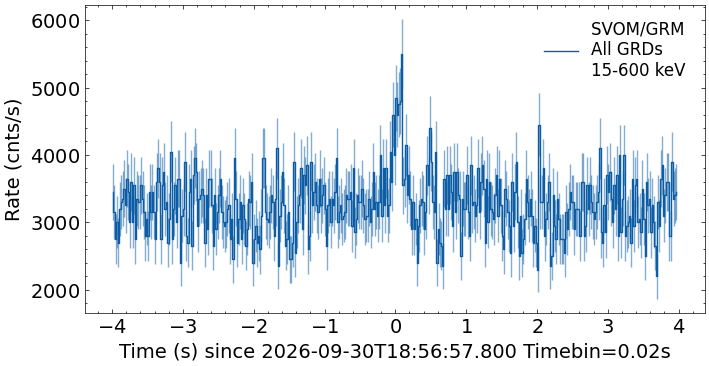
In addition, the position of this burst, as determined by GECAM-B (RA = 326.3, Dec = 24.1, Error = 8.6 deg, GCN #45802), is located at about 70 degrees from the SVOM optical axis, which is outside the ECLAIRs field of view.
With this localization, the time-averaged spectrum from T0-0.5 to T0+0.5 s is best fitted by a power law function with an exponential high-energy cutoff. The power law index is 1.08 +0.28/-0.41 and the cutoff energy, parameterized as Epeak, is 348 +856/-151 keV. The event fluence (10-1000 keV) in this time interval is (5.46 +1.34/-1.17)E-07 erg/cm^2.
The Space Variable Objects Monitor (SVOM) is a China-France joint mission led by the Chinese National Space Administration (CNSA, China), National Center for Space Studies (CNES, France) and the Chinese Academy of Sciences (CAS, China), which is dedicated to observing gamma-ray bursts and other transient phenomena in the energetic universe. GRM is developed by the Institute of High Energy Physics (IHEP) of CAS.
The SVOM/GRM point of contact for this burst is: Zheng-Hang Yu (IHEP) (zhyu@ihep.ac.cn)
Every one of the gamma-ray bursts GCN reports is posted here.
Relayed automatically from NASA's General Coordinates Network.
In plain words Routine
A short flash of gamma rays (the most energetic form of light) was recorded on 30 September 2026 by the SVOM satellite, and the same burst was also seen by two other spacecraft, Fermi and GECAM-B. The flash lasted under a second, with a few quick pulses followed by one more pulse. That points to the short type of gamma-ray burst, which is often linked to the merger of two dense stellar remnants, though the report does not say what caused this one. The position is only roughly known, somewhere in a patch of sky several degrees wide near the constellation region at coordinates RA 326, Dec +24, and it was outside the field of view of SVOM's sharper-eyed X-ray camera. No distance, afterglow or visible counterpart is mentioned in this report.
How unusual is it? This is an ordinary short gamma-ray burst of the kind Fermi and others catch many times a year, with a coarse position and no distance or afterglow reported. Finding an afterglow or a gravitational-wave signal at the same time and place would raise it to notable.
Written by an AI model (claude-sonnet-5-5) from the official reports in this thread; last updated . It may contain mistakes: the reports themselves are the authority.
GRB 260930B — GRB, X-ray Transient