
GCN Circular 45858
GRB 261005A: GECAM-B observation
From: unknown
Issued: 2026-10-08 12:19 UTC
Type: GRB, Gamma-ray Transient
Hao-Xuan Guo, Chen-Wei Wang, Chao Zheng, Shao-Lin Xiong (IHEP) report on behalf of GECAM team:
GECAM-B was triggered on-ground by GRB 261005A, at 2026-10-05T20:19:04.500 UTC (denoted as T0), which is also detected by Fermi/GBM (Fermi GBM team, GCN #45811) and Glowbug (C.C. Cheung et al., GCN #45820).
According to the GECAM-B light curves in about 70-6000 keV, this burst mainly consists of a single pulse with a duration (T90) of 9.0 +5.0/-5.5 s.
The GECAM-B light curve can be found here: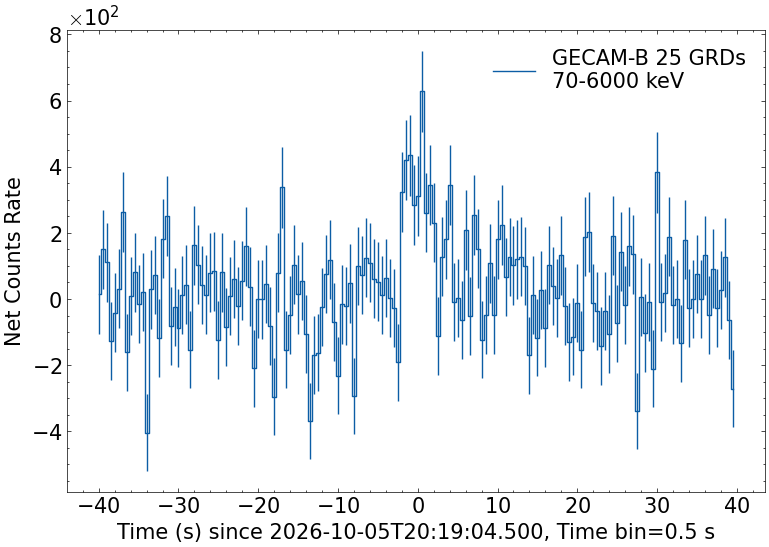
Gravitational wave high-energy Electromagnetic Counterpart All-sky Monitor (GECAM) mission originally consists of two micro-satellites (GECAM-A and GECAM-B) launched in Dec. 2020. As the third member of GECAM constellation, GECAM-C was launched onboard SATech-01 experimental satellite in July 2022. GECAM mission is funded by the Chinese Academy of Sciences (CAS).
Every one of the gamma-ray bursts GCN reports is posted here.
Relayed automatically from NASA's General Coordinates Network.
Transient Alerts » in reply to GRB 261005A
In plain words Routine
A burst of gamma rays, the most energetic form of light, reached Earth on 5 October 2026 and was recorded by three separate space telescopes: Fermi, Glowbug (an experiment on the International Space Station) and China's GECAM-B. Fermi places it in the constellation region around 22h 39m right ascension and +5.5 degrees declination, but only roughly, with an uncertainty of about 6 degrees. Fermi classed it as a likely long burst, the kind usually linked to the collapse of a massive star. Glowbug measured a single peak lasting about 5 seconds, and GECAM-B estimated about 9 seconds with a large margin of error. No distance, afterglow or visible-light counterpart has been reported so far.
How unusual is it? This is a typical single-pulse long gamma-ray burst, of a kind Fermi and Swift see a few hundred times a year, with only a rough location and no distance or afterglow reported. A measured distance or a detected afterglow would make it notable.
Written by an AI model (claude-sonnet-5-5) from the official reports in this thread, and rewritten as new reports arrived (version 2); last updated . It may contain mistakes: the reports themselves are the authority.
GRB 261005A: GECAM-B observation