
GCN Circular 45863
GRB 261007A: SVOM/GRM observation
From: unknown
Issued: 2026-10-08 15:46 UTC
Type: GRB, X-ray Transient
SVOM/GRM team: Yang-Zhao Ren, Chen-Wei Wang, Shi-Jie Zheng, Yue Huang, Shao-Lin Xiong, Shuang-Nan Zhang (IHEP)
SVOM/ECLAIRs team: Olivier Godet (IRAP)
Report on behalf of the SVOM team:
SVOM/GRM was triggered in-flight by GRB 261007A (SVOM trigger reference: sb26100701) at 2026-10-07T05:39:49.800 UTC (T0), which is also detected by SVOM/ECLAIRs (Hatsune Goto et. al., GCN #45824), EP (Wen et. al., GCN #45828), Fermi/GBM (Fermi GBM team, GCN #45830), NuSTAR (Waratkar et. al., GCN #45846) and AstroSat/CZTI (Harsha et. al., GCN #45859).
With the event-by-event data downloaded through the X-band ground station, the GRM light curve shows that this burst consists of multiple pulses with a T90 of 25.0 +0.5/-0.5 s in the 15-5000 keV band.
The SVOM/GRM light curve can be found here: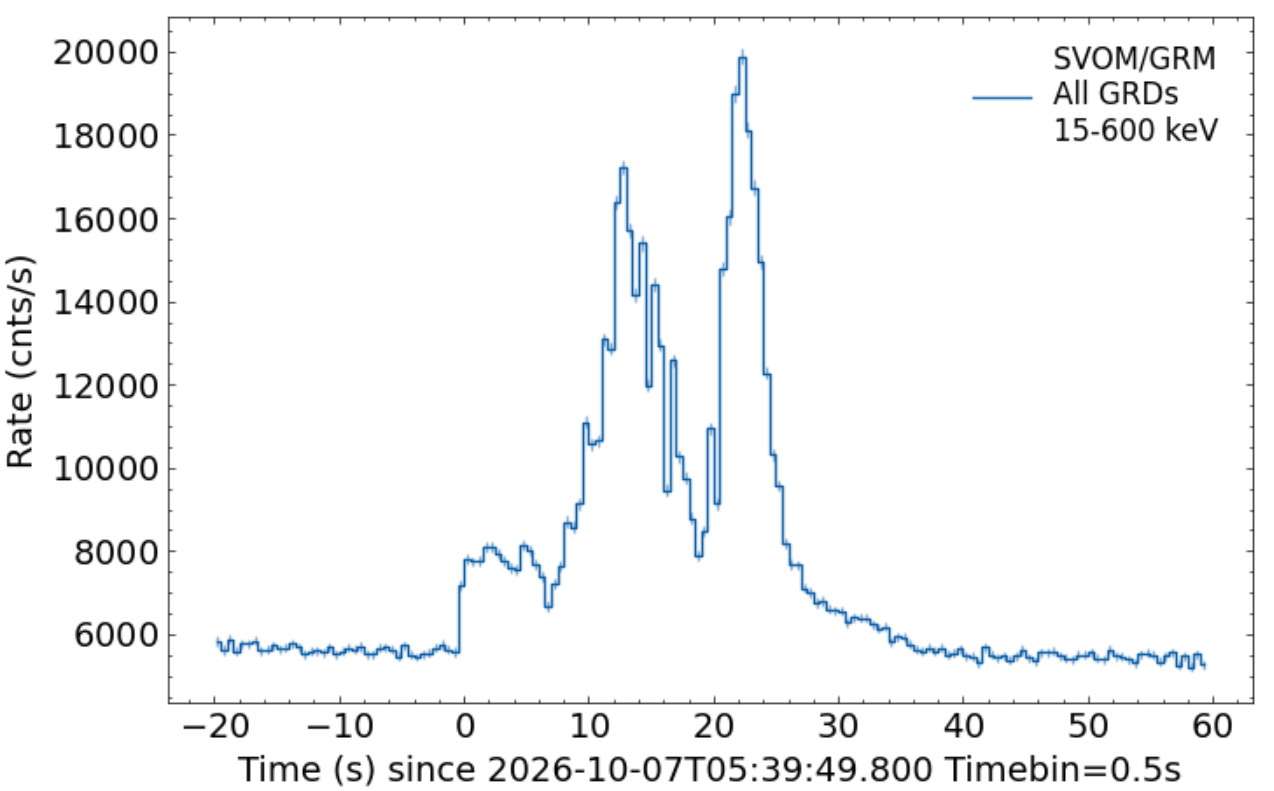
In addition, the position of this burst, as determined by SVOM/ECLAIRs (RA= 11.5787 deg, Dec=-17.6698 deg, ERR= 9.61 arcmin, GCN #45824), is located at about 28 degrees from the SVOM optical axis.
With this localization, the time-averaged spectrum from T0 to T0+30 s is best fitted by a power law function with an exponential high-energy cutoff. The power law index is -0.66 +0.02/-0.02 and the cutoff energy, parameterized as Epeak, is 316 +8/-7 keV. The event fluence (10-1000 keV) in this time interval is (8.54 +0.13/-0.12)E-05 erg/cm^2.
The 1s peak spectrum, measured from T0+21.7 to T0+22.7 s, if fitted by a power law function with an exponential high-energy cutoff, the power law index is -0.59 +0.03/-0.03 and the cutoff energy, parameterized as Epeak, is 322 +14/-13 keV. The flux (10-1000 keV) in this time interval is (2.85 +0.05/-0.04)E-06 erg/cm^2/s.
The localization of GRB 261007A in the 'Amati' relation diagram is shown at: 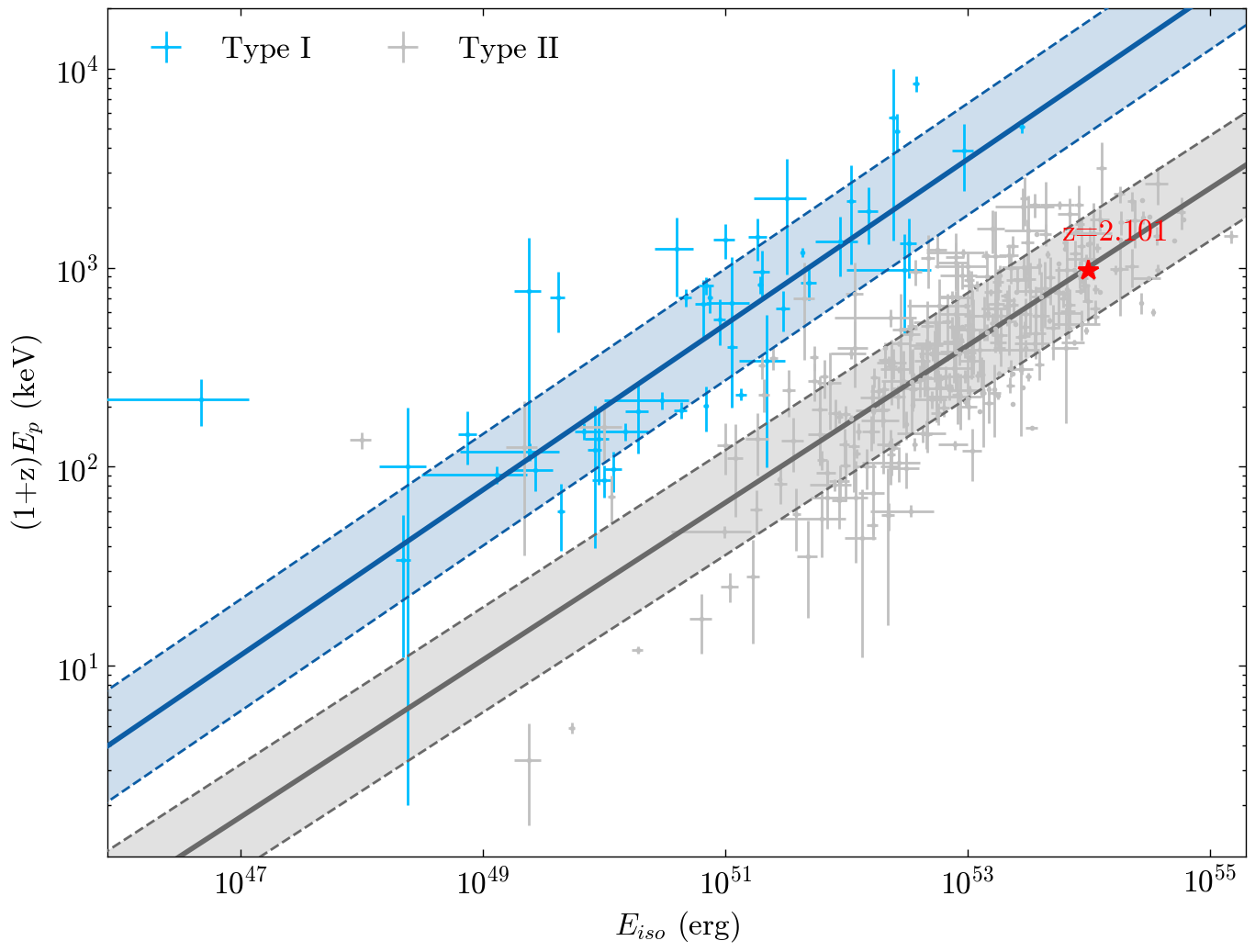
The localization of GRB 261007A in the 'Yonetoku' relation diagram is shown at: 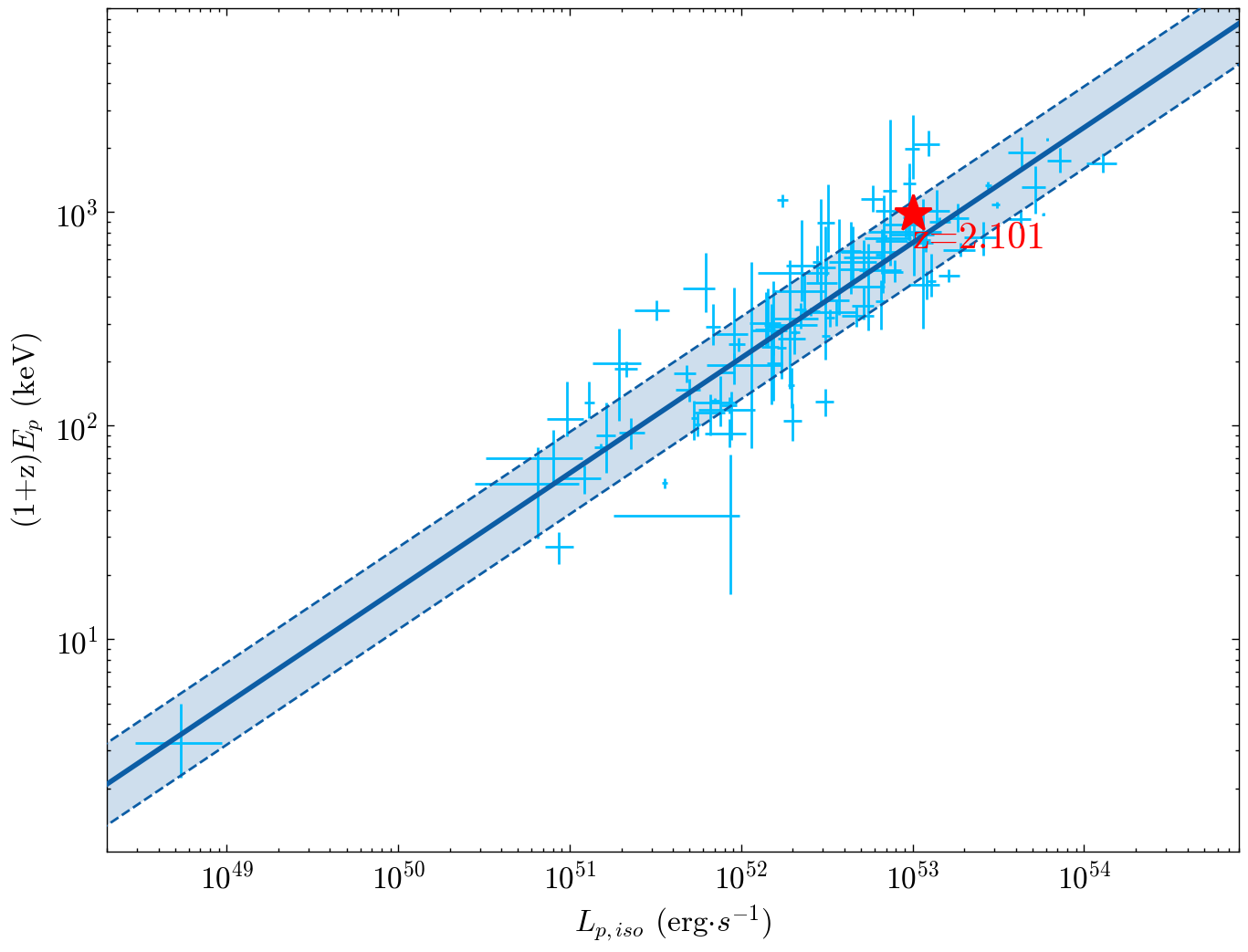
The Space Variable Objects Monitor (SVOM) is a China-France joint mission led by the Chinese National Space Administration (CNSA, China), National Center for Space Studies (CNES, France) and the Chinese Academy of Sciences (CAS, China), which is dedicated to observing gamma-ray bursts and other transient phenomena in the energetic universe. GRM is developed by the Institute of High Energy Physics (IHEP) of CAS.
The SVOM point of contact for this burst is: Yang-Zhao Ren (IHEP)(renyz@ihep.ac.cn)
Every one of the gamma-ray bursts GCN reports is posted here.
Relayed automatically from NASA's General Coordinates Network.
Transient Alerts » in reply to GRB 261007A — GRB, X-ray Transient
In plain words Notable
A burst of gamma rays, the most energetic form of light, was detected on 7 October 2026 by SVOM, a China-France satellite, and by several other space telescopes, including Fermi, NuSTAR, AstroSat and the Einstein Probe. It came from a spot in the southern sky and lasted about 23 seconds, which makes it a long gamma-ray burst, the kind usually linked to the death of a massive star. Within minutes, ground telescopes found a fading optical afterglow, and Swift later detected an X-ray afterglow at the same position. A large telescope in Chile (the VLT) measured the distance from the afterglow's light: the explosion happened about 2.1 in redshift, meaning the light left roughly 10 billion years ago. The afterglow was bright at first, around magnitude 15 within two minutes, and had faded to about magnitude 21 a day later, as expected.
How unusual is it? A spectroscopic redshift (z = 2.101) and a bright optical afterglow caught within minutes and followed in X-rays by many telescopes make this better studied than most of the few hundred bursts seen each year, but the burst itself looks like a typical long gamma-ray burst, not a record-breaker.
Written by an AI model (claude-sonnet-5-5) from the official reports in this thread, and rewritten as new reports arrived (version 5); last updated . It may contain mistakes: the reports themselves are the authority.
GRB 261007A: SVOM/GRM observation
The whole thread (20 posts)
- GRB 261007A — GRB, X-ray Transient
- GRB 261007A: NOT optical observations
- GRB 261007A: SVOM/GRM observation
- GRB 261007A: AstroSat CZTI detection
- GRB 261007A/EP261007a: Optical follow-up observations with Kinder
- GRB 261007A / EP261007a: SVOM/VT optical observations
- GRB 261007A: Swift-XRT afterglow detection
- GRB 261007A: SVOM/COLIBRÍ (FM-GFT) optical observations
- GRB 261007A / EP261007a: NuSTAR detection of prompt emission
- GRB 261007A / EP261007a: ULL-ASTRO-MASTER detection of the optical afterglow with LCO 40-cm telescope at McDonald Observatory
- Autonomous identification and follow-up of the counterpart to GRB 261007A by BTSbot with ZTF and P60/SEDM
- GRB 261007A: GROWTH-India Telescope optical observations
- GRB 261007A / EP261007a: TRT optical observations
- GRB 261007A: Swift ToO observations
- GRB 261007A: SVOM/C-GFT optical observations
- GRB 261007A / EP261007a: LCO optical observations
- GRB 261007A: WINTER J-band observations
- GRB 261007A: Fermi GBM observation
- GRB 261007A / EP261007a: VLT/X-shooter spectroscopic redshift z = 2.101
- GRB 261007A: KAIT optical counterpart candidate