The Jupiter Icy Moons Explorer (JIMO) places the nuclear reactor at the forward tip, with a thick shield behind. The conical shape of the spacecraft fits inside the relatively radiation-free volume behind the shield.
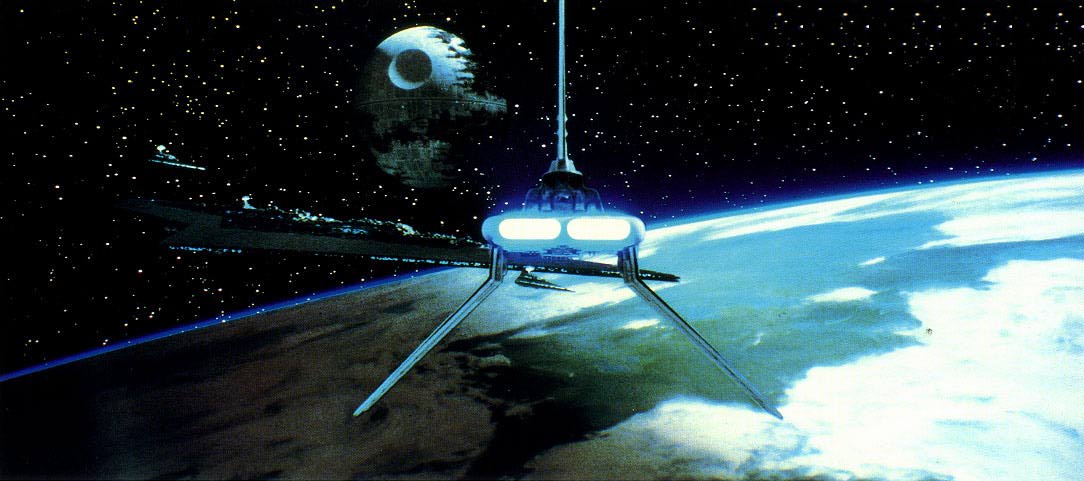
JIMO is reminiscent of the Imperial Star Destroyer from George Lucas' Star Wars Trilogy, and one wonders if it too was supposed to have a nuclear reactor at the forward end. Sci-fi writers and directors have been known to consult with scientists about some things. So this begs the question: Was the geometry of the Imperial Star Destroyer designed by intuition, or prior knowledge?


Cool Quote:
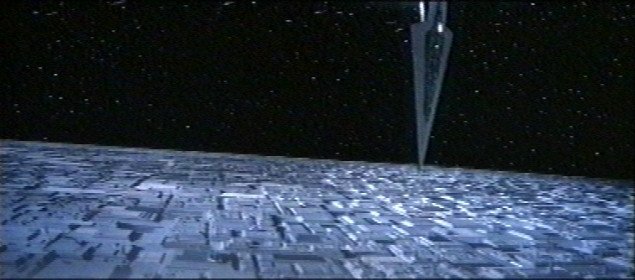
It is theoretically possible to measure the length of the Executor by reference to the second Death Star. A careful examination of the curvature of the horizon of the Death Star in the scene where the Executor plunged to its doom should in principle produce the radius of the Death Star to the same scale. The absolute length of the ship could be determined assuming the true dimensions of the battle station.
In Return of the Jedi the diameter of the Endor moon is consistently 11.5±0.1 times that of the Death Star. This calculation can be accurately measured from the hologram in the rebel briefing, and from the whole-disk view of both bodies which was seen when the Rebel Alliance fleet emerged from hyperspace. To proceed from this point, it is necessary to know the absolute size of the moon.
The mass of the moon is loosely constrained by planetary physics. Too small a moon will not be able to hold a breathable atmosphere under the comfortable temperature conditions enjoyed by ewoks. The moon must therefore have a surface gravity which is a significant fraction of Earth's. At the same time, the Ewok hang-gliders would probably be unable to fly with exactly human-standard gravity (unless the atmospheric pressure at ground level is much greater than terrestrial conditions). Surface gravity of about 2/3 g seems reasonable; (it could only be stronger if the moon is endowed with a dense atmosphere; but the gravity cannot be much lower because of the atmosphere-loss constraint).
If the composition of the moon does not depart drastically from that of terrestrial planets in our solar system then the best solution for its size gives density of about 4.5 g/cm³ and a radius of about 5200±300km. This gives an approximate Death Star radius of about 450±26km. For further information read Death Stars.
It ought to be possible to fix the Executor's size by using this radius to scale the crash scene.
Unfortunately this elaborate method collapses in practice. The Death Star II's horizon curvature is so slight that tiny uncertainties in measurement lead to large uncertainties in results. Put bluntly, this technique is too imprecise. My own initial efforts with this technique produced values for the ratio of Executor length to Death Star radius varying from 0.038 up to about 0.18. The lowest horizon result for the Executor's size yields a length of 17±2km, which is in agreement with the length calculations based on a one-mile star destroyer length. "
source
Imperial Executor-Class Star Destroyer : Intuition or Prior-Knowledge?