
"Above a certain frequency water is dissociated quite efficiently by UV light. UV light is about 6% of the solar spectrum. If 1% of the total flux is high enough, then some ~25 W per square metre of stratosphere is going into dissociation. It takes roughly 460 kJ/mol of water to bust it up - about 25 MJ/kg. Thus about 1/1,000,000th of a kg is dissociated per second per square metre."
'Question - I read an answer to a question by Vince Calder
about "Laser Splitting Water" and he said that "Water does not absorb electromagnetic radiation in the ultraviolet region until very short wavelengths less ~253 nm." '
http://www.newton.dep.anl.gov/askasci/chem03/chem03867.htm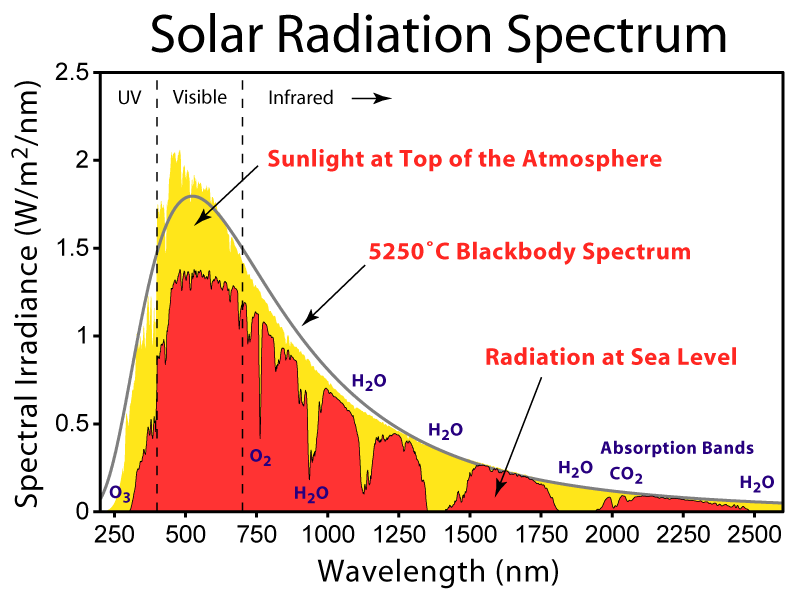
If I'm reading this graph correctly there doesn't seem to be much energy in the total solar flux which is less than "~253 nm". Perhaps, 1 % of total flux is too high, but even if were 1/100th of 1 % if it were to efficiently split water, it wouldn't matter much as far as this discussion whether it's less than million or as much as 100 million years.
Transparency:
"The Sun emits ultraviolet radiation in the UVA, UVB, and UVC bands, but because of absorption in the atmosphere's ozone layer, 98.7% of the ultraviolet radiation that reaches the Earth's surface is UVA. (Some of the UVB and UVC radiation is responsible for the generation of the ozone layer.)
Ordinary glass is partially transparent to UVA but is opaque to shorter wavelengths while Silica or quartz glass, depending on quality, can be transparent even to vacuum UV wavelengths. Ordinary window glass passes about 90% of the light above 350 nm, but blocks over 90% of the light below 300 nm."
http://en.wikipedia.org/wiki/Ultraviolet
[Ultraviolet A, long wave UVA 400 nm–320 nm
Ultraviolet B or medium wave UVB 320 nm–280 nm
Ultraviolet C, short wave, or germicidal: UVC 280 nm–100 nm ]
In first reference it mentions:
" Solar irradiance is not a constant. The radiation and particle output changes in various cycles that vary daily, weekly, ..., decades. So it is difficult to specify what the effect of "direct sunlight" might be, because it is constantly changing."
I wonder if these short waves are more affected by "the varying densities of space" or the small amount of dust between the Sun and Earth. Perhaps there is 10 to 20% more Ultraviolet in the total flux at Venus distance.
Anyhow, back to the issue of UV being quite efficient at splitting water. We could generate Ultraviolet C in the range that would split water. Why isn't it done in order to make Hydrogen.
And would you predict that passive collectors of UV from the Sun be used on the Moon or elsewhere to split water?
Space/Science » in reply to UV light
re: UV light