
GCN Circular 46283
GRB 261113B: Insight-HXMT/HE detection
From: Xinghao Luo at IHEP
Issued: 2026-11-15 01:47 UTC
Type: GRB, Gamma-ray Transient
Xing-Hao Luo, Chen-Wei Wang, Chao Zheng, and Shao-Lin Xiong (IHEP) report on behalf of the Insight-HXMT team:
At 2026-11-13T19:45:55.000 (T0), Insight-HXMT/HE detected the GRB 261113B, which is also detected by Fermi/GBM (Fermi GBM team, GCN#46281).
The Insight-HXMT/HE light curve mainly consists of multiple pulses with a T90 of 8.0 +3.5/-6.0 s. The 1s peak rate, measured from T0+0.25 s, is 811 cnts/sec. Insight-HXMT/HE detected a total of 1434 counts from this burst.
The HXMT/HE light curve can be found here: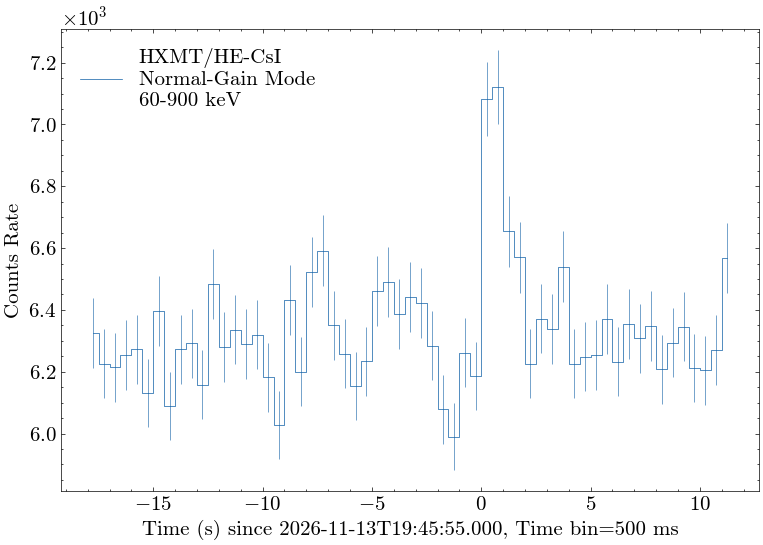
All measurements above are made with the CsI detectors of Insight-HXMT/HE operating in the regular mode with the energy range of about 60-900 keV (deposited energy). Only gamma-rays with energy greater than about 200 keV can penetrate the spacecraft and leave signals in the CsI detectors installed inside of the telescope.
Insight-HXMT is the first Chinese space X-ray telescope, which was funded jointly by the China National Space Administration (CNSA) and the Chinese Academy of Sciences (CAS). More information about it could be found at: HOME-Insight-HXMT-EN (hxmten.ihep.ac.cn)
Every one of the gamma-ray bursts GCN reports is posted here.
Relayed automatically from NASA's General Coordinates Network.
Transient Alerts » in reply to GRB 261113B — GRB, Gamma-ray Transient
In plain words Notable
On 13 November 2026, several gamma-ray satellites (Fermi, Insight-HXMT, GECAM-B and SVOM) all detected a burst of gamma rays, a flash of very high-energy light that usually comes from a distant exploding star or other violent cosmic event. It lasted roughly 10 to 18 seconds depending on the instrument, which makes it a 'long' burst, the kind usually linked to the collapse of a massive star. It came from the direction of the constellation Ursa Major, near the Big Dipper. A ground-based optical telescope network (SVOM/GWAC) reported a possible visible-light counterpart at a position consistent with Fermi's location, but the reports here give no details about it. No distance has been reported, and the burst's brightness is ordinary.
How unusual is it? A possible optical counterpart was reported by SVOM/GWAC, and the Fermi location agrees with it, which is a step beyond most bursts. The burst itself is otherwise typical (moderate fluence, ordinary long duration), and the counterpart is not yet confirmed; a measured distance (redshift) or confirmation as a fading afterglow would solidify the verdict, while a non-GRB source for the optical signal would make this routine.
Written by an AI model (claude-sonnet-5-5) from the official reports in this thread, and rewritten as new reports arrived (version 5); last updated . It may contain mistakes: the reports themselves are the authority.
GRB 261113B: Insight-HXMT/HE detection