
GCN Circular 46311
GRB 261113B: SVOM/GRM observation
From: Xinghao Luo at IHEP
Issued: 2026-11-17 06:13 UTC
Type: GRB, X-ray Transient
SVOM/GRM team: Xing-Hao Luo, Yue Wang, Chen-Wei Wang, Shi-Jie Zheng, Yue Huang, Shao-Lin Xiong, Shuang-Nan Zhang (IHEP)
SVOM/ECLAIRs team: Stéphane Schanne (CEA)
Report on behalf of the SVOM team:
SVOM/GRM was triggered on-ground by GRB 261113B at 2026-11-13T19:45:55.250 (T0), which is also detected by Fermi/GBM (Fermi GBM team, GCN#46281) and Insight-HXMTHE (Xing-Hao Luo et.al., GCN#46283).
With the event-by-event data downloaded through the X-band ground station, the GRM light curve shows that this burst consists of multi-pulses with a T90-value of 10.5 +1.5/-2.5 s in the 15-5000 keV band.
The SVOM/GRM light curve can be found here: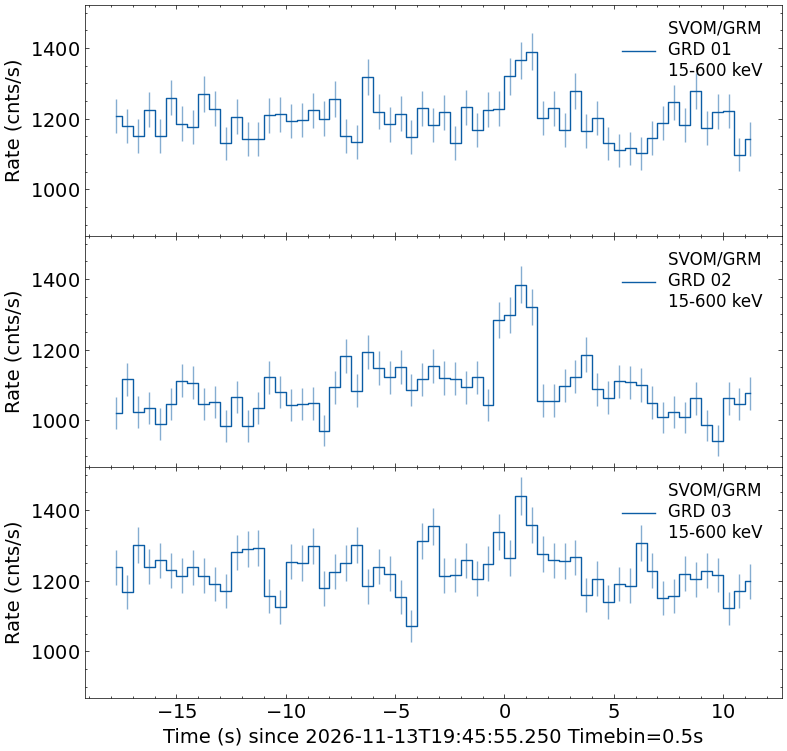
In addition, the position of this burst, as determined by SVOM/GWAC (RA = 164.7397862 deg, Dec = 43.9302714 deg J2000, with a statistical uncertainty of 0.5 arcseconds, L. P. Xin et.al., GCN #46276), is located at about 131 degrees from the SVOM optical axis, which is outside the ECLAIRs field of view. It was seen by GRM as reflected on the Earth atmosphere.
With this localization, the time-averaged spectrum from T0-7.75 to T0+4.25 s is best fitted by a power law function. The the powerlaw index is -2.09 +0.15/-0.11 and the event fluence (10-1000 keV) in this time interval is (9.09 +1.09/−1.07)E-06 erg/cm^2.
The Space Variable Objects Monitor (SVOM) is a China-France joint mission led by the Chinese National Space Administration (CNSA, China), National Center for Space Studies (CNES, France) and the Chinese Academy of Sciences (CAS, China), which is dedicated to observing gamma-ray bursts and other transient phenomena in the energetic universe. GRM is developed by the Institute of High Energy Physics (IHEP) of CAS.
The SVOM/GRM point of contact for this burst is: Xing-Hao Luo (IHEP) (luoxh@ihep.ac.cn)
Every one of the gamma-ray bursts GCN reports is posted here.
Relayed automatically from NASA's General Coordinates Network.
Transient Alerts » in reply to GRB 261113B — GRB, Gamma-ray Transient
In plain words Notable
On 13 November 2026, several gamma-ray satellites (Fermi, Insight-HXMT, GECAM-B and SVOM) all detected a burst of gamma rays, a flash of very high-energy light that usually comes from a distant exploding star or other violent cosmic event. It lasted roughly 10 to 18 seconds depending on the instrument, which makes it a 'long' burst, the kind usually linked to the collapse of a massive star. It came from the direction of the constellation Ursa Major, near the Big Dipper. A ground-based optical telescope network (SVOM/GWAC) reported a possible visible-light counterpart at a position consistent with Fermi's location, but the reports here give no details about it. No distance has been reported, and the burst's brightness is ordinary.
How unusual is it? A possible optical counterpart was reported by SVOM/GWAC, and the Fermi location agrees with it, which is a step beyond most bursts. The burst itself is otherwise typical (moderate fluence, ordinary long duration), and the counterpart is not yet confirmed; a measured distance (redshift) or confirmation as a fading afterglow would solidify the verdict, while a non-GRB source for the optical signal would make this routine.
Written by an AI model (claude-sonnet-5-5) from the official reports in this thread, and rewritten as new reports arrived (version 5); last updated . It may contain mistakes: the reports themselves are the authority.
GRB 261113B: SVOM/GRM observation