Granted, not manmade, but still approaching:
Ikeya-Zhang on March 13.
105mm lens mounted on a homemade barn-door star tracker.
Brightness and contrast adjusted with Photoshop.
Image Credit: Phillip Hoffman.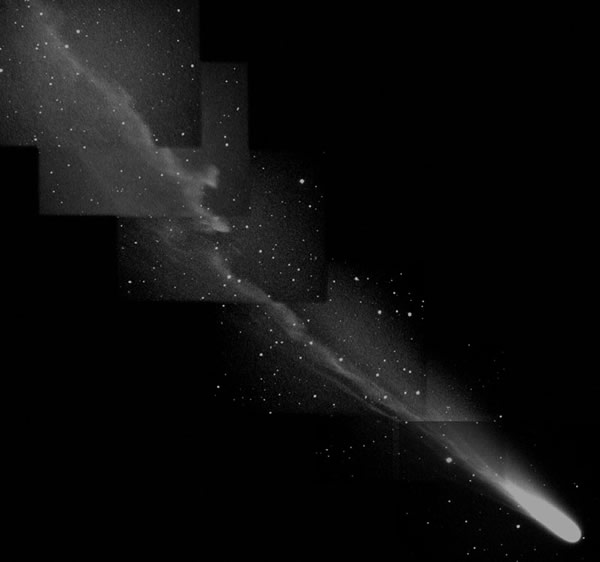

"It appears I caught a disruption event in the tail of comet Ikeya-Zhang on the evening of 3/11/02. I re-imaged the comet on 3/12/02 and the tail had re-stabilized.
Each frame in the mosaic is 10x15second exposures using an ST-237A CCD camera on a C8 with Fastar at F1.95."
Image Credit: Gil Jones.
As for your proposed experiment, I seriously think it would be pointless for you to do this. You have already shown a complete disregard for scientific fact. The data will show you to be incorrect, and I seriously believe you would most probably discount the experiment for some conspiracy theory, and you'll demand a second and third similar experiment, ad infinitum.
Please know that the above is NOT flame, but merely the image of yourself you have displayed to me.
For myself, I would find the additional data fascinating, showing improvements to the current comet model, but I seriously doubt it will change any laws of physics. The tails are formed through heat, cometary breakup and outgassing, caused by interaction with the Sun and the Solar wind. The dust trail follows along the comet's orbit, while the excited ion trail in thrown from the comet away from the Sun in the gales of the Solar wind (averaging 400 km/s with an average particle density of 1 to 20 protons/cc, which is quite sufficient to chew up the delicate crust of an inbound comet.
You also had a question in your initial post regarding a photo of a comet and the fade of surrounding stars. The comet is by far the brightest object, ergo the stars in the field of the comet are drowned by its brightness. This is an error that cameras make, and why it’s best to photograph your subject with the sunlight at your back. The Sun is likely brighter than your subject. The same is true when viewing a comet from Earth, due to glare interacting with the Earth’s atmosphere. To get a true view of the comet and the backfield of stars, you must personally go there and look at it.
Dan
Space/Science » in reply to Re: Your Comment
Re: There's one out there to look at now . . .
The whole thread (30 posts)
- Oh no, more on comet tales
- Re: Oh no,...Perhaps both arguments are
- Re: Here is another link I missed earlier
- Re: Comment to Dan & the board members . . .