
In any case its' the shockwave that does the damage. If you thought my description of the Halifax Disaster was bad, read this: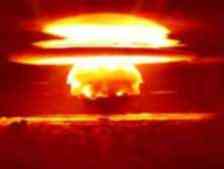
Early in the morning on March 1, 1954, the hydrogen bomb, code named Bravo, was detonated on the surface of the reef in the northwestern corner of Bikini Atoll. The area was illuminated by a huge and expanding flash of blinding light. A raging fireball of intense heat that measured into the millions of degrees shot skyward at a rate of 300 miles an hour. Within minutes the monstrous cloud, filled with nuclear debris, shot up more than 20 miles and generated winds hundreds of miles per hour. These fiery gusts blasted the surrounding islands and stripped the branches and coconuts from the trees.
Joint Task Force ships, which were stationed about 40 miles east and south of Bikini in positions enabling them to monitor the test, detected the eastward movement of the radioactive cloud from the 15 megaton blast. They recorded a steady increase in radiation levels that became so high that all men were ordered below decks and all hatches and watertight doors were sealed.
Millions of tons of sand, coral, plant and sea life from Bikini's reef, from three islands [Bokonijien, Aerokojlol, Nam] and the surrounding lagoon waters were sent high into the air by the blast. One-and-a-half hours after the explosion, 23 fishermen aboard the Japanese fishing vessel, the Lucky Dragon, watched in awe as a "gritty white ash" began to fall on them. The men aboard the ship were oblivious to the fact that the ash was the fallout from a hydrogen bomb test. Shortly after being exposed to the fallout their skin began to itch and they experienced nausea and vomiting. One man died.
Meanwhile, on Rongelap Atoll (located about 125 miles east of Bikini), three to four hours after the blast, the same white, snow-like ash began to fall from the sky onto the 64 people living there and also onto the 18 people residing on Ailinginae Atoll. Bravo was a thousand times more powerful than the Fat Man and Little Boy atomic bombs that were dropped on Nagasaki and Hiroshima during the end of World War II. Its "success" was beyond the wildest dreams of the American scientists who were involved in the detonation--they thought that the blast would only carry a payload of approximately 3 megatons.
The Rongelapese, not understanding what was happening, watched as two suns rose that morning, observed with amazement as the radioactive dust soon formed a layer on their island two inches deep turning the drinking water a brackish yellow. Children played in the fallout; their mothers watched in horror as night came and they began to show the physical signs of exposure. The people experienced severe vomiting and diarrhea, their hair began to fall out, the island fell into a state of terrified panic.
source
What remains of the Bikini Atol and the three surrounding islands is today just a crater in the seafloor, visible from aircraft:
(1954 Bravo Hydrogen bomb crater)
Current Events » in reply to Re: Just a thought
Re: The water in a sea port is not very deep