
Greenback woes
The US dollar is suffering in relation to other currencies, dropping over 20% in the last year.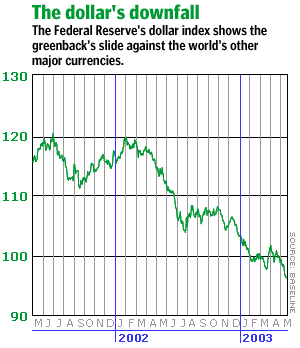
What gives?
For one thing, the prospect of interest rates, already at 41-year lows, staying in the gutter indefinitely will discourage foreign investors from buying interest-bearing U.S. assets, such as bonds.
After all, why go shopping for interest-rate products in the United States, where the Fed's target rate is 1.25 percent, when you can shop for them in Europe, where the European Central Bank's target rate is twice as big, at 2.5 percent?
"The decision to shift to a weakness bias should trigger further dollar weakness across the board, as the United States remains a funding currency against the higher yielders like the Canadian dollar, Australian dollar and New Zealand dollar," said HSBC Bank USA currency strategist Meg Browne.
More abstractly, some traders might worry the Fed's warning of deflation -- despite interest rates at 41-year lows, which should be inflationary -- makes the United States look less like ancient Rome or Queen Victoria's Britain and more like 1990s-era Japan.
In Japan, policy makers have slashed interest rates to near zero, and the government has poured money into the economy, but deflation and economic weakness have persisted for the better part of a decade.
This is ominous news, in the sense that foreign money is the drug the American
economy desperately needs to function normally. The U.S. current account -- a measure of the money flowing into and out of the country that includes the trade of goods and services -- ran a whopping deficit in 2002 of $503 billion, or about 5.3 percent of gross domestic product (GDP). That percentage is expected to climb even higher in 2004. Throw in the surging deficit in the federal budget, which is likely to approach $400 billion, or more than 4 percent of GDP, this year, and you have the recipe for a "twin deficit" scenario worse than the one that preceded trouble for the dollar and U.S. stocks in the late 1980s. Such deficits aren't a problem as long as overseas investors keep pumping money into U.S. assets, financing America's ability to live beyond its means. If foreign investors start looking elsewhere, however -- as they've already begun to do -- stock and bond prices fall, bond yields and interest rates rise, slowing down borrowing and economic growth, and the dollar falls even further. "
CNN Money
I'm no economist, but these don't seem to be good signs for the US.