
Reality check
Your analogy, as usual, bites wind. An asteroid hit is something analyzable by hard math and ballistics, not trying to guess the weather from computer models where the outcome depends solely on what you decide to put in, and what algorithms you're going to throw at it.
This is the IPCC summary of the problem. There is enough waffling in this paper to open a chain of IHOPs. Note the section on widespread coastal flooding (emphasis mine).
Very large sea-level rises that would result from widespread deglaciation of Greenland and West Antarctic ice sheets imply major changes in coastlines and ecosystems, and inundation of low-lying areas, with greatest effects in river deltas. Relocating populations, economic activity, and infrastructure would be costly and challenging. There is medium confidence that at least partial deglaciation of the Greenland ice sheet, and possibly the West Antarctic ice sheet, would occur over a period of time ranging from centuries to millennia for a global average temperature increase of 1-4°C (relative to 1990-2000), causing a contribution to sea level rise of 4-6 m or more. The complete melting of the Greenland ice sheet and the West Antarctic ice sheet would lead to a contribution to sea-level rise of up to 7 m and about 5 m, respectively [Working Group I Fourth Assessment 6.4, 10.7; Working Group II Fourth Assessment 19.3].
Based on climate model results, it is very unlikely that the Meridional Overturning Circulation (MOC) in the North Atlantic will undergo a large abrupt transition during the 21st century. Slowing of the MOC this century is very likely, but temperatures over the Atlantic and Europe are projected to increase nevertheless, due to global warming. Impacts of large-scale and persistent changes in the MOC are likely to include changes to marine ecosystem productivity, fisheries, ocean carbon dioxide uptake, oceanic oxygen concentrations and terrestrial vegetation [Working Group I Fourth Assessment 10.3, 10.7; Working Group II Fourth Assessment 12.6, 19.3].
Add up the timelines and the "likelihoods." What kind of near-term threat of "Florida flooding" is really expressed there?
All the rest of it is the brilliant observation that as climate changes, ecosystems will alter to adapt. Duh. Did people really think that the current status quo of the planetary ecosystem was a plateau that would be maintained forever if we all just switched to windmills?
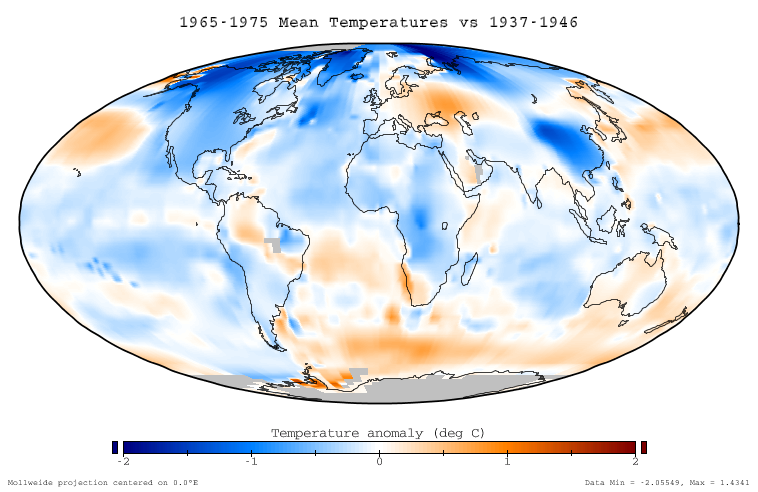
We just came out of a climate minimum in the 1800s. Is it that bizarre to think that maybe a warming trend might be natural? When things cooled off from the 40s to the 70s, the height of "dirty industry" in the U.S., does it bother anyone that the "consensus" had to come up with a kludge to explain it while still clinging to the "CO2 is killing us all" theory?
The reason "consensus" is required on human-caused global warming is that so much of it is uncertain. Be sure to read Endbox 2 in that paper, which has a detailed description of all the waffle flavors.