
GCN Circular 46008
GRB 261017A: SVOM/GRM observation
From: xueyuan zao
Issued: 2026-10-22 03:12 UTC
Type: GRB, X-ray Transient
SVOM/GRM team: Xue-Yuan Zao, Yue Wang, Shi-Jie Zheng, Yue Huang, Shao-Lin Xiong, Shuang-Nan Zhang (IHEP)
SVOM/ECLAIRs team: Oliver Godet (IRAP)
Report on behalf of the SVOM team:
SVOM/GRM was triggered in-flight by GRB 261017A at 2026-10-17T16:05:06 UTC (T0), which is also detected by Fermi/GBM (Fermi GBM Team, GCN #45973) and Swift (Siegel et al., GCN #45974).
With the event-by-event data downloaded through the X-band ground station, the GRM light curve shows that this burst consists of multiple pulses with a T90 of 12.5 +4.9/-3.5 s in the 15-5000 keV band.
The SVOM/GRM light curve can be found here: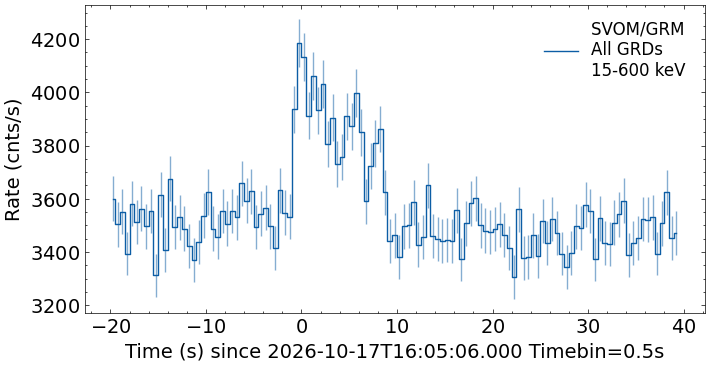
In addition, the position of this burst, as determined by Swift/XRT (RA= 139.9 degrees, DEC=12.6 degrees, ERR=4.8 arcseconds), is located at about 154.4 degrees from the SVOM optical axis, which is outside the ECLAIRs field of view. Nevertheless, the burst was detected through the ECLAIRs shielding.
The Space Variable Objects Monitor (SVOM) is a China-France joint mission led by the Chinese National Space Administration (CNSA, China), National Center for Space Studies (CNES, France) and the Chinese Academy of Sciences (CAS, China), which is dedicated to observing gamma-ray bursts and other transient phenomena in the energetic universe. GRM is developed by the Institute of High Energy Physics (IHEP) of CAS.
The SVOM point of contact for this burst is: Xue-Yuan Zao (IHEP)(zaoxy@ihep.ac.cn)
Every one of the gamma-ray bursts GCN reports is posted here.
Relayed automatically from NASA's General Coordinates Network.
Transient Alerts » in reply to GRB 261017A
In plain words Notable
On 17 October 2026 a burst of gamma rays lasting about 9 to 12 seconds was seen by several space telescopes (Fermi, Swift, Konus-Wind and SVOM) coming from a spot in the constellation Cancer region of the sky near RA 139.9, Dec +12.6. Swift also found a fading X-ray afterglow there, which pins the position down to a few arcseconds. Searches in visible and infrared light found nothing, down to very faint limits, and Swift's ultraviolet camera saw only a doubtful, flickering source that a later Russian telescope could not confirm. No distance has been measured. One group noted that the burst's very fast flickering (about 0.03 seconds) and its energy pattern resemble those of rare long bursts thought to come from two dense stars merging, like GRB 230307A, rather than from a collapsing massive star. That is a suggestion, not a confirmed identification.
How unusual is it? Most gamma-ray bursts are routine, but this one lasted several seconds yet shows a very fast variability timescale and an energy pattern that one analysis says match merger-driven long bursts such as GRB 230307A, and it has an X-ray afterglow. The merger origin is unconfirmed, with no redshift and no clear optical counterpart. A confirmed optical or infrared kilonova (the glow from a neutron-star merger) or a measured distance would raise this to exceptional, while a typical collapsing-star sign
Written by an AI model (claude-sonnet-5-5) from the official reports in this thread, and rewritten as new reports arrived (version 6); last updated . It may contain mistakes: the reports themselves are the authority.
GRB 261017A: SVOM/GRM observation
The whole thread (18 posts)
- GRB 261017A
- GRB 261017A: SVOM/GRM observation
- GRB 261017A: SAO RAS optical upper limit
- GRB 261017A: COLIBRÍ optical upper limit
- Explainer: what this is and why it matters (AI-written)
- Konus-Wind detection of GRB 261017A
- GRB 261017A: Possible Swift/UVOT Detection
- GRB 261017A: Luminance-band upper limit from a 28cm telescope in Chengde
- GRB 261017A: R-band upper limit with the 1.3-m DFOT
- GRB 261017A: Swift-BAT refined analysis
- GRB 261017A: a short minimum variability timescale compatible with a compact object merger origin
- GRB 261017A: J band upper limit by the SYSU 80cm infrared telescope
- GRB 261017A : MITSuME Akeno optical upper limits
- GRB 261017A: Swift-XRT refined Analysis
- GRB 261017A: Nanshan/NEXT optical upper limit
- GRB 261017A: Enhanced Swift-XRT position
- GRB 261017A: Fermi GBM Observation
- GRB 261017A: Swift detection of a burst