
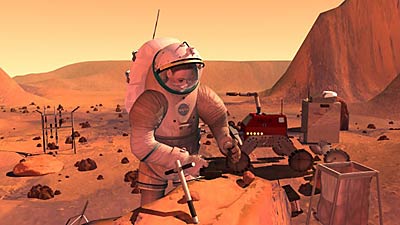
Humans, augmented with robot helpers, may be the most
efficient way to explore Mars. (credit: NASA)
Giving future human space explorers the credit they’re due
by Anthony Kendall
Monday, October 31, 2005
The debate surrounding the value of human versus robotic exploration has largely ignored the fact that humans are vastly more capable of exploring planetary surfaces than are robotic rovers. Indeed, Mars-analog exploration conducted by the Mars Society suggests that humans can do “rover science†thousands of times faster than rovers. Rovers are incapable of conducting even a small fraction of the science humans are capable of, including the most important Martian science objectives: detailing its geologic history and searching for fossil or living organisms. If current thinking prevails, it will be in vain pursuit of these two objectives that billions more will be spent on increasingly expensive rovers, while a single human mission could be conducted more quickly, with greater likelihood of mission success, and even at lower cost.
Of all possible targets for inner solar system exploration, Mars exploration is the most attractive because it offers both important science objectives and broad public enthusiasm. Though per-haps not strictly necessary, as a variety of big science and engineering projects (such as the CERN particle accelerator and the ITER fusion project) demonstrate, broad public enthusiasm is absolutely vital in maintaining the budget of a decadal-long space exploration program. Mars is the closest planetary body that is both capable of being immediately explored and potentially ca-pable of harboring life, making its exploration one of the most exciting scientific, engineering, and societal challenges facing the world today. Thus, any chosen surface exploration regime, be it robotic, human, or both, should be the one that provides the capability to succeed as quickly, and cheaply, as possible.
More at: http://www.thespacereview.com/article/483/1
Giving future human space explorers the credit they’re due
The whole thread (28 posts)
- Giving future human space explorers the credit they’re due