
"The simple physics explanations for the greenhouse effect that you find on the internet are often quite wrong. These well-meaning errors can promote confusion about whether humanity is truly causing global warming by adding carbon dioxide to the atmosphere. Some people have been arguing that simple physics shows there is already so much CO2 in the air that its effect on infrared radiation is "saturated"— meaning that adding more gas can make scarcely any difference in how much radiation gets through the atmosphere, since all the radiation is already blocked. And besides, isn't water vapor already blocking all the infrared rays that CO2 ever would?"
A Saturated Gassy Argument
Linked from http://climatedebatedaily.com/
[top article of Calls to action]
He goes on explain that CO2 is evenly mixed throughout the atmosphere, whereas water vapor is not and that the infrared radiation has to work it way up through the atmosphere and that it's the higher atmosphere which critical in regards the "greenhouse affect"- which he thinks is better described as:
"As a dam built across a river causes a local deepening of the stream, so our atmosphere, thrown as a barrier across the terrestrial [infrared] rays, produces a local heightening of the temperature at the Earth's surface."
So, yes in the stratosphere and above the air is very dry- and the reason it's dry is because very cold air can't hold water vapor:
""The water-vapor content of the air varies considerably, depending on the temperature and
relative humidity. With 100 percent relative humidity the water-vapor content of air varies
from 190 parts per million (ppm) at -40° C (-40° F) to 42,000 ppm at 30° C (86° F)"
worldalmanacforkids
"The stratosphere is situated between about 10 km (6 miles) and 50 km (31 miles) altitude above the surface at moderate latitudes, while at the poles it starts at about 8 km (5 miles) altitude."
...
The stratosphere is layered in temperature because it is heated from above by absorption of ultraviolet radiation from the Sun. Within this layer, temperature increases as altitude increases (see temperature inversion); the top of the stratosphere has a temperature of about 270 K (−3°C or 26.6°F), just slightly below the freezing point of water."
http://en.wikipedia.org/wiki/Stratosphere
But at bottom of stratosphere [top of the troposphere] it gets really cold. For every 1000' increase in elevation you get about 3 F decrease in temperature, so if it's 90F at an elevation of 1000', at 31,000' it's somewhere around 0 F.
Wiki says this:
"More generally, the actual rate at which the temperature drops with altitude is called the environmental lapse rate. In the troposphere, the average environmental lapse rate is a drop of about 6.5 °C for every 1 km (1000 meters) increase in height."
...
"Temperatures decrease at middle latitudes from an average of 15°C at sea level to about -55°C at the beginning of the tropopause. At the poles, the troposphere is thinner and the temperature only decreases to -45°C, while at the equator the temperature at the top of the troposphere can reach -75°C"
http://en.wikipedia.org/wiki/Troposphere
The beginning of above link says:
"The troposphere is the lowest portion of Earth's atmosphere. It contains approximately 75% of the atmosphere's mass and almost all of its water vapor and aerosols."
So, above 10km [30,000'+] the air is very thin, and gets thinner the higher you go, at 45,000' you can't breath air without pressure suit [just an oxygen mask will not allow one to breath] and at 100,000' [20 miles] the atmosphere is as thin as Mars' atmosphere. And at 60 miles [100 km] you get astronaut wings if you get this high [but Earth's atmosphere continues with Themosphere at 350 Km and Exosphere- beyond where International Space Station flies].
So at the beginning of the stratosphere and up, one has a huge chunk of the sky with very little stuff per volume in it.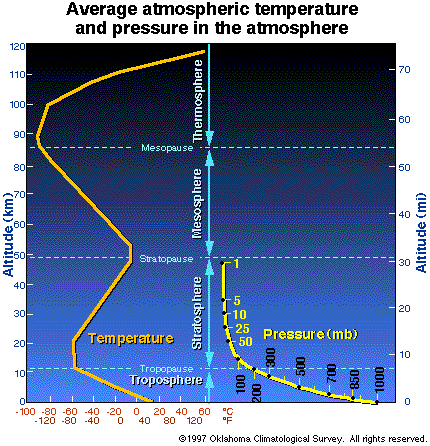
So, at start of Stratosphere, there is about 1/5 the atmospheric pressure as sea level and by the top Stratosphere it's 1/1000th. If CO2 is well mixed and at 380 ppm at sea level pressure, than though there may 380 ppm at 10 km elevation, it's 380 ppm of a much thinner atmosphere, so it's 1/5th of something which .038% of the atmosphere. You talking about quantities that in comparison make Mars seem like it has a dense rich atmosphere, and the Moon which is considered be a very good vacuum seem as though it has an atmosphere. And this stuff is supposed to cause significant global warming?
Flame » in reply to Forget global warming: Welcome to the new Ice Age
A Saturated Gassy Argument
The whole thread (37 posts)
- Forget global warming: Welcome to the new Ice Age
- A Saturated Gassy Argument
- Please select one of the following options
- re:one AND five are correct
- What was the atmospheric pressure at sealevel in 1940. What is it today?
- Nooooooooooooooooo
- Yes Tony.... Search your feelings.... you know it to be true...
- re: Yes Tony and brothers L. I will start my research on the subject if
- re: Yes Tony and brothers L. I will start my research on the subject if
- Because your memory of a book you read long ago...
- re: Yes Tony and brothers L. I will start my research on the subject if
- Yes Tony.... Search your feelings.... you know it to be true...
- Nooooooooooooooooo
- What was the atmospheric pressure at sealevel in 1940. What is it today?
- re: Please select one of the following options
- re: options
- re: Please select one of the following options
- re:one AND five are correct