
GCN Circular 45939
GRB 261011A: GECAM-B observation
From: Jin-Ye Luo
Issued: 2026-10-13 12:29 UTC
Type: GRB, Gamma-ray Transient
Jin-Ye Luo, Chen-Wei Wang, Yue Wang, Shao-Lin Xiong (IHEP) report on behalf of GECAM team:
GECAM-B was triggered on-ground by GRB 261011A at 2026-10-11T13:49:15.250 UTC (denoted as T0), which is also detected by SVOM/ECLAIRs (Huang et al., GCN #45895), Swift/BAT (Cenko et al., GCN #45896; Barthelmy et al., GCN #45930), and Konus-Wind (Ridnaia et al., GCN #45924).
According to the GECAM-B light curves in about 70-6000 keV, this burst mainly consists of muplti-pulses with a duration (T90) of 40 +21/-9 s.
The GECAM-B light curve can be found here: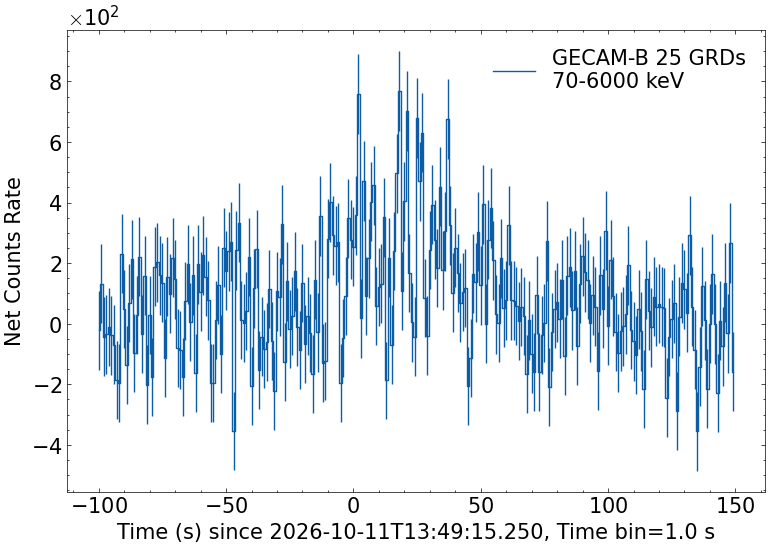
Gravitational wave high-energy Electromagnetic Counterpart All-sky Monitor (GECAM) mission originally consists of two micro-satellites (GECAM-A and GECAM-B) launched in Dec. 2020. As the third member of GECAM constellation, GECAM-C was launched onboard SATech-01 experimental satellite in July 2022. GECAM mission is funded by the Chinese Academy of Sciences (CAS).
Every one of the gamma-ray bursts GCN reports is posted here.
Relayed automatically from NASA's General Coordinates Network.
Transient Alerts » in reply to GRB 261011A — GRB, X-ray Transient
In plain words Notable
On 11 October 2026 two satellites, SVOM and Swift, caught a long gamma-ray burst (a brief flash of high-energy light from a distant exploding star) in the southern sky. It lasted roughly a minute or more, depending on the instrument. Within minutes, telescopes around the world saw a fading visible-light and X-ray afterglow at the same spot. Two large telescopes measured the distance from the light's fingerprints: the burst happened at redshift 2.407, meaning the light left roughly 11 billion years ago. The afterglow faded below detection within about a day, and no host galaxy has been clearly detected. It is most likely an ordinary long burst from the collapse of a massive star. Swift's first report of an unusual light curve was withdrawn after a closer look showed that part of it came from noisy detectors.
How unusual is it? Most gamma-ray bursts have no measured distance, but this one has a confirmed redshift (2.407) from two independent telescopes plus a bright afterglow seen in many wavelengths; otherwise its properties look typical, and the initially reported oddity turned out to be instrumental noise.
Written by an AI model (claude-sonnet-5-5) from the official reports in this thread, and rewritten as new reports arrived (version 9); last updated . It may contain mistakes: the reports themselves are the authority.
GRB 261011A: GECAM-B observation
The whole thread (32 posts)
- GRB 261011A — GRB, X-ray Transient
- GRB 261011A: 1.3m DFOT optical upper limit
- GRB 261011A: SAO RAS and AbAO optical observations
- GRB 261011A: Later-epoch J-band upper limit from the SYSU 80 cm infrared telescope
- GRB 261011A: GECAM-B observation
- GRB 261011A: Swift-XRT refined Analysis
- GRB 261011A: Enhanced Swift-XRT position
- GRB 261011A: 10.4m GTC spectroscopic redshift (z = 2.407)
- GRB 261011A: Swift-BAT refined analysis
- GRB 261011A: REM optical/NIR observations
- Konus-Wind detection of GRB 261011A
- Updated explainer: what the latest reports add (AI-written)
- GRB 261011A: SOAR optical afterglow observations at ~17 hours
- GRB 261011A: VLT/X-shooter redshift constraints
- GRB 261011A : MITSuME Akeno optical afterglow candidate detection
- GRB 261011A: Optical followup from Sichuan South Observatory
- GRB 261011A: GMG Optical Observation
- GRB 261011A: Liverpool Telescope optical observations
- GRB 261011A: J-band observations by the SYSU 80cm infrared telescope
- GRB 261011A: continued LCO optical observations
- GRB 261011A: GROWTH-India Telescope optical observations
- GRB 261011A: Optical upper limits with a 28cm telescope in Chengde
- Swift GRB 261011A: Global MASTER-Net observations report
- GRB 261011A: Optical follow-up observations with Kinder
- GRB 261011A: SVOM/C-GFT optical observations
- GRB 261011A: LCO optical observations
- GRB 261011A: SVOM/VT optical observation from VHF data
- GRB 261011A: LCO optical observations
- GRB 261011A: TRT optical afterglow detection
- Explainer: what this is and why it matters (AI-written)
- GRB 261011A: GOTO optical counterpart detection
- GRB 261011A: Swift detection of an unusual burst