
The practicality of drastically reducing Green-House Gas emissions... (pt.1 of ?)
This is in response to TB's post here entitled Some analysis of the "Climate Security Act" in which he linked to Energy Wedgists versus Technology Breakthroughists an article on Reason Online by Ronald Bailey.
The article essentially argues that the required CO2 reduction cannot be accomplished because of the magnitude of the problem. In order to illustrate his point he throws up a series of numbers that supposedly show the impossibility of just eliminating 1 gigaton/year of CO2 production:
So just how big is a gigaton? Cutting a gigaton of carbon dioxide is equivalent to replacing 1,000 conventional 500-megawatt coal-fired electric generation plants with zero-emission plants. Zero-emission might mean coal-fired plants using carbon capture and sequestration (CCS) technologies, perhaps costing as much as $80 per ton. By some estimates, CCS would increase the cost of producing electricity by 25 to 40 percent. Cutting another gigaton would be equal to building 500 one-gigawatt nuclear power plants. The world currently has 439 nuclear plants in operation. One gigaton more would require increasing the number of windmills operating in the U.S. by 150-fold, or increasing solar photovoltaics by 10,000-fold. It would take farming an area 15-times the size of Iowa to produce the biomass to replace 1 gigaton of carbon dioxide emissions.
His argument is not just intentionally misleading, it is in some aspects just plain wrong. The author apparently got many of his numbers from Genomics:GTL Roadmap: Systems Biology for Energy and Environment, U.S. Department of Energy Office of Science, August 2005. DOE/SC-0090. The claim "Cutting a gigaton of carbon dioxide is equivalent to replacing 1,000 conventional 500-megawatt coal-fired electric generation plants with zero-emission plants." is incorrect, (it doesn't agree with other government numbers, numbers done by others, and numbers I calculated) - and most of the other numbers are irrelevant and thrown in there because they are large and thus make the challenge look impossibly daunting.
THE NUMBERS
World Anthropogenic CO2(2004): 27.2 GT List of CO2 contribution by country
US Anthropogenic CO2 (2004): 6.05 GT/year (%20.2 of world total)
US electricity generation is responsible for %41 of US CO2 production, or 2.5GT/year
Coal is used for half of our electricity generation and contributes more than half of the CO2 production due to electricity generation.

#(Checking numbers: 1999 data (http://www.eia.doe.gov/cneaf/electricity/page/co2_report/co2report.html#electric) says US energy production was responsible for 2.24GT/year, with 1.8GT/year from coal... little different from 2004 data)#
Additionally, our reliance on coal and natural gas releases the Global warming equivalent CO2 of ~.18 gigatons in the form of Methane. Coal and natural gas are responsible for 1/3rd of the united states Methane emissions.
When broken down in terms of energy use by sector, it can be seen that Electric power generation and Transportation are the two leading contributors to US CO2 emissions:

Source: Energy Information Administration, preliminary estimate for 2007.
China's CO2 production(2004) was 5GT/year (%18.4 of world total) with %69 of their electricty generation coming from coal. (China most likely became the top producer of CO2 in 2006)
According to preliminary data, five new coalfired generators with a combined capacity of 600 megawatts came online in the United States in 2006, while India added 930 megawatts of capacity. In startling contrast, China brought online about as much coal power capacity each week as the United States and India together did over the entire year, adding an unprecedented 90 gigawatts in 2006.
Coal Use Rises Dramatically Despite Impacts on Climate and Health
If that doesn't worry you, read it again!
As a political entity China is now the top producer of CO2.
In comparison France's CO2 production is .37GT/year (%1.4 of world total), and only %3.9 of their electricity is generated by Coal, %78.1 is nuclear.

Nuclear Power generated 425.8 TWh out of the France's total production of 540.6 TWh in 2002.
SO HOW MUCH IS A GIGATON, REALLY....?
Coal power produces ~2.1 pounds of CO2 per kW h
1kW*year= 8760kWh, 1kW from coal over a year creates 18,400 pounds of CO2/year= 8.4 tons CO2/year, 1MW from coal over a year creates 8400 tons of CO2/year, A 500MW coal plant then releases 4,200,000 Tons of CO2 per year (VERY close to other sources estimate). This means that 238 coal power plants operating at 500MW create 1GT of CO2 per year. Less than a quarter of the 1000 stated in the above article.
Lets look at one claim made in the article, "One gigaton more would require increasing the number of windmills operating in the U.S. by 150-fold..."- This claim is not supported by the facts. In 2007 the wind power capacity in the United States was ~17GW United States was ~17GW. This capacity must be multiplied by a capacity factor that reflects the variability of wind power, typically capacity factor values range between .2-.4. Lets take the worst case value of .2, this means actual wind power generation was 3.4 GW. From the calculation above, replacing coal generation of 119 GW with zero emission power would reduce CO2 emissions by 1gigaton per year. This would require increasing wind power electricity generation by a factor of 35, NOT the 150 claimed by the article.
Another way you could go, as mentioned in the article, is to replace the coal plants with coal burning plants that capture and sequester the carbon dioxoide (CCS). At a cost of $80 per ton of CO2 captured and sequestered (A cost figure in line with other sources) you can calculate the additional cost per kW*hour:
1kWh=2.1lbs=.00095 tons of CO2, at $80/ton for sequestration this gives a cost of 7.6 cents per kWh for coal power electricity, An infinitely more detailed economic study:"Carbon Dioxide Capture from Existing Coal-Fired Power Plants" DOE study pg 139, table 3-65 gives a cost increase ranging from 2.3cents (30% CO2 reduction) to 6.9 cents (90% CO2 reduction) per kWhr for a given coal plant.
If CCS becomes mandatory this would lead to a steep increase in the cost of electricity from coal. The effect on the economy can be debated, it would be a hardship, certainly, but we have weathered worse increases in fuel prices- take the price of gasoline adjusted for inflation:
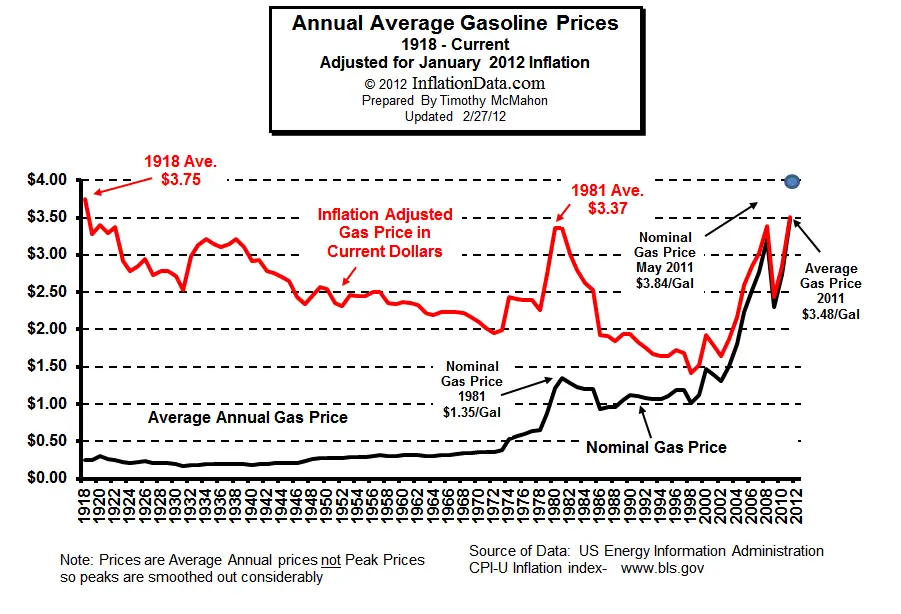
Gasoline prices have more than doubled in the past decade.
While CCS is a theoretical option, it is in NO way the best option. The optimal solution is to replace coal power with power from sources that do not create CO2 in the first place. Obvious alternatives are Nuclear, Hydro-electric, solar, and wind. Lets just consider nuclear for the purposes of this post (I am in no way dismissing Hydro-electric as a significant part of the solution).
#num check: 1GT of CO2= 238 coal power plants operating at 500MW for a year = 238*5*10^8 *8760 kWh=~1,000 TWh, US generates ~4000TWh of which ~1600 TWh is from coal which implies coal power in US generates ~1.6 GT/year of CO2 from coal. most sources say 1.7-1.8 GT so my numbers are pretty close#
Since 238 coal power plants operating at 500MW for a year generate 1GT of CO2 it would take, using the logic of the article TB linked to, 119 1GW nuclear power plants to replace them and cut US CO2 emissions by 1GT per year, a %17 reduction. Replacing ALL coal power with nuclear, or other zero emission generation, would reduce US emissions by 1.8GT, or %30. Replacing the electricity power we currently get from coal would require ~214 1GW new nuclear power plants. The US currently has 104 nuclear power plants. Replacing Natural gas with zero emission as well would reduce emissions even further.
-R.L.
(To be continued...)