The practicality of drastically reducing Green-House Gas emissions... (pt.2 of ?)
ARRELL — (archived)
PART 2 IS NUCLEAR POWER ECONOMICALLY VIABLE?
Obviously, if generating electricity via nuclear power is far more expensive than coal, there is no economic incentive to go nuclear (The environmental imperative is unchanged, and the fact is we MUST drastically reduce GHG emissions).However, the reality of the situation is that power generation by nuclear is actually the cheapest way:
US cost figures for 2007 published by the Energy Utility Cost Group showed nuclear utility generating costs averaging 2.866 c/kWh, comprising 1.832 c/kWh operation and maintenance, 0.449 c/kWh fuel and 0.585 c/kWh capital expenditure (NB apparently not amortisation of the plants). US figures from a different source for 2007 published by NEI gave 1.68 c/kWh for fuel plus O&M.
Note: the above data refer to fuel plus operation and maintenance costs only, they exclude capital, since this varies greatly among utilities and states, as well as with the age of the plant.
In 2004, production expenses averaged $18.26 per megawatthour for nuclear reactors and $23.85 per megawatthour for fossil fuel plants. “U.S. Nuclear Regulatory Commission (NRC) 2006–2007 Information Digest†pg 14
The 'high cost of nuclear power' is not because nuclear power is costly to operate and manage, on the contrary- from an operations cost standpoint nuclear is the most cost effective, the cost is due to the high initial investment in building a nuclear power plant. Obviously there was a time when it was economically reasonable to go nuclear, yet no new plants ordered in the past 3 decades have been completed. France's overwhelming reliance on nuclear power also would seem to argue that the there is nothing intrinsically impractical about using nuclear power. The rate at which construction costs increased is staggering:
For example, Commonwealth Edison, the utility serving the Chicago area, completed its Dresden nuclear plants in 1970-71 for $146/kW, its Quad Cities plants in 1973 for $164/kW, and its Zion plants in 1973-74 for $280/kW. But its LaSalle nuclear plants completed in 1982-84 cost $1,160/kW, and its Byron and Braidwood plants completed in 1985-87 cost $1880/kW — a 13-fold increase over the 17-year period. Northeast Utilities completed its Millstone 1,2, and 3 nuclear plants, respectively, for $153/kW in 1971, $487/kW in 1975, and $3,326/kW in 1986, a 22-fold increase in 15 years. Duke Power, widely considered to be one of the most efficient utilities in the nation in handling nuclear technology, finished construction on its Oconee plants in 1973-74 for $181/kW, on its McGuire plants in 1981-84 for $848/kW, and on its Catauba plants in 1985-87 for $1,703/kW, a nearly 10-fold increase in 14 years. Philadelphia Electric Company completed its two Peach Bottom plants in 1974 at an average cost of $382 million, but the second of its two Limerick plants, completed in 1988, cost $2.9 billion — 7.6 times as much. A long list of such price escalations could be quoted, and there are no exceptions. Clearly, something other than incompetence is involved.
A large part of the cost escalation can be explained by the increased construction time of nuclear power plants:
The total cost of a power plant is defined as the total amount of money spent up to the time it goes into commercial operation. In addition to the cost of labor and materials which are represented by the EEDB we have been discussing up to this point, there are two other very important factors involved:
The cost escalation factor (ESC), which takes into account the inflation of costs with time after project initiation. Inflation for construction projects has been about 2% per year higher than general inflation as represented by the consumer price index (CPI).2 For example, between 1973 and 1981, the average annual price increase was 11.5% for concrete, 10.2% for turbines, and 13.7% for pipe, but only 9.5% for the CPI.3 For each item, the ESC depends on how far in the future it must be purchased: the basic engineering, for example, will be done shortly after the project begins and hence its cost is hardly affected by inflation. But an instrument that can be installed rapidly and is not needed until the plant is ready to operate may not be purchased for 10 years. If the assumed inflation rate is 12% per year, which was typical of the late 1970s and early 1980s, its cost will have tripled by that time (1.12^10 = 3 ).
A factor covering the interest charges (INT) on funds used during construction (this is closely related to what is commonly called AFUDC, allowance for funds used during construction). All money used for construction must be borrowed or obtained by some roughly equivalent procedure. Hence the interest paid on it up to the time the plant goes into operation is included in the total cost of the plant. For example, the basic engineering may involve salaries paid 12 years before the plant becomes operational. If the annual interest rate is 15%, its cost is therefore multiplied by (1.15^12 =) 5. Note that the interest which increases item 2 is normally a few points higher than the inflation rate that increases item 1; it is therefore advantageous to delay money outlays for as long as possible.
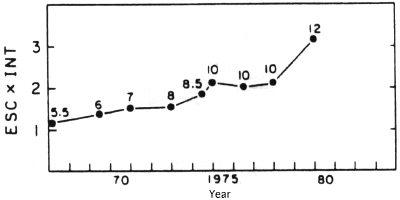
Items 1 and 2 depend almost exclusively on two things, the length of time required for construction, and the rate of inflation (interest rates, averaged over long time periods are closely tied to inflation). If there were no inflation, or if plants could be built very rapidly, these factors would be close to 1.0, having little impact on the cost. http://www.phyast.pitt.edu/~blc/book/totalcost.gif The product of the inflation and interest factors. This is the factor by which the EEDB from Fig. 1 must be multiplied to obtain total cost. The figures above the points are the estimated number of years for the project at its initiation date.
The product of these two factors, ESC x INT, used in the United Engineers estimates at various project initiation dates, is plotted in Fig. 2. The number of years required for construction is given above each point. We see that ESC x INT was only 1.17 in 1967, when construction times were 5.5 years and the inflation rate was 4% per year. It increased to 1.45 in 1973, when construction times stretched to 8 years but inflation rates were still only 4% per year. It went up to 2.1 in 1975-1978, when construction times lengthened to 10 years and the inflation rate averaged about 7% per year, and jumped to 3.2 in 1980 when construction times reached 12 years and the inflation rate soared to 12% per year. That is, the cost of a plant started in 1980 would have been more than triple the EEDB cost; 69% of the final cost would have been for inflation and interest.
From this analysis we can understand two more important reasons, besides skyrocketing labor prices, that explain why costs of nuclear plants completed during the 1980s were so high: their construction times were much longer than in earlier years, and they were being built during a period of high inflation.
There are multiple reasons for the increased time of construction, legal challenges from environmentalists certainly played a part, but the primary problems seem to be:
There were massive cost overruns for plants built in the USA in the 1970's and 1980's. There were several reasons for these.
Design Flaws. There were significant design flaws which led to the reactor leak and operator confusion that caused the Three Mile Island accident. After these were exposed, the US Nuclear Regulatory Commission (NRC), undertook an extensive review of Nuclear Plant designs and in many cases ordered changes. These changes were both expensive and time consuming to fix. They led to extensive construction delays at a time of very high interest rates and so significantly increased the cost of the Capital required to build the plant.
Two hurdle licensing. Up until the mid-1990's developers of nuclear power plants had to obtain both a license to build a Nuclear Power then a subsequent license to operate the plant. This also delayed the start of plant operation which significantly increased the cost of the plant. The worst situation was that of the Shoreham Plant which was completed on Long Island in New York State at a cost of 5 Billion dollars but was never allowed to operate.
Non-uniform designs. The US Nuclear Power Industry never achieved economies of volume because every reactor design was different. Each developer put in their own tweaks and much of the equipment was custom built for each plant. This compounded the difficulties of obtaining NRC licensing approval since the NRC had to evaluate each individual design.
In contrast the French Nuclear Power program settled on a standard design which satisfied the French Regulatory Commission. Industry was able to achieve economies of volume in the production of plants and to complete construction on time.
In many cases, ever changing regulations would force redesign of nuclear power plants while they were under construction- clearly that would be financially disasterous! Certainly a standardized design, as in the French model, would greatly improve the situation. Simply copying the French design and using it is a possibility, of course, but it wouldn't take advantage of new technologies, and wouldn't deal with the toxic regulatory environment already in place that was created in a haphazard fashion- an environment that reflected the public's fear of nuclear power more than it reflected the reality. Newer, cheaper reactor designs have been suggested:
Construction costs are very difficult to quantify but dominate the cost of Nuclear Power. The main difficulty is that third generation power plants now proposed are claimed to be both substantially cheaper and faster to construct than the second generation power plants now in operation throughout the world. The Nuclear Industry says its learned the lessons of economy-of-volume demonstrated by the French Nuclear Program, and that these will be employed for the new power plants. Westinghouse claims its Advanced PWR reactor, the AP1000, will cost USD $1400 per KW for the first reactor and fall to USD $1000 per KW for subsequent reactors. They also claim these will be ready for electricity production 3 years after first pouring concrete. A more technical description is here. Proponents of the CANDU ACR and Gas Cooled pebble bed reactors make similar or stronger claims. This should be compared to second generation plants which, in the U.S.A., had construction costs up to $5000 per KW and generally took more than five years to complete.
The General Electric ABWR was the first third generation power plant approved. The first two ABWR's were commissioned in Japan in 1996 and 1997. These took just over 3 years to construct and were completed on budget. Their construction costs were around $2000 per KW. Two additional ABWR's are being constructed in Taiwan. However these have faced unexpected delays and are now at least 2 years behind schedule.
Meanwhile the Chinese Nuclear Power Industry has won contracts to build new plants of their own design at capital costs reported to be $1500 per KW and $1300 per KW at sites in South-East and North-East China. If completed on budget these facilities will be formidable competitors to the Western Nuclear Power Industry.
Given the history of Nuclear Plant construction in the U.S.A., the financial industry sees the construction of the new generation of reactors as a risky investment and demands a premium on capital lent for the purpose. The Energy Bill recently passed by the US Congress assumes this risk and provides production credits of 1.8 cents per KW-Hr for the first 3 years of operation. This subsidy is equivalent to what is paid to Wind Power companies and is designed to encourage new nuclear reactor construction in the USA.
If the AP1000 lives up to its promises of $1000 per KW construction cost and 3 year construction time, it will provide cheaper electricity than any other Fossil Fuel based generating facility, including Australian Coal power, even with no sequestration charges.
So, to recap, nuclear power generation is the most cost effective way of generating electricity, AND the high capital costs of the past do not need to be the deal-breakers that they once were. The problem with nuclear would seem to be that its haunted by the ghosts of the past. Nuclear power is viewed as extremely high financial risk and, given the history, it is a view that has been earned. Government created this mess, and as much as it may make people wince, government must take the responsibility to admit its mistakes and undo the tangle it has created.