I'll grant you that "viscous fingering" is scientifically interesting and CAN create similar images. However, I have also found viscous fingering images that look NOTHING like the spiders.
So, here's one example I found that DOES look like spiders:
But note this article linked from the Wikipedia article on Lichtenbergs:
http://classes.yale.edu/fractals/Panorama/Physics/DLA/DBM/DBM2.html
That's right, diffusion limited aggregates are described in ELECTRICAL terms as a dielectric breakdown. Hmm, interesting, ain't it? And ain't that what I said about Lichtenberg formation. Charge, dielectric breakdown, discharge, Lichtenberg scarring... Hmm. Ain't that amusing?
But there are plenty of viscous fingering examples that look NOTHING like the spiders or which only bear superficial resemblance.
So, what would cause the viscous fingering in the case of "spiders" to look NEARLY identical each and every single time? And not look like say, this:
http://www.acclaimimages.com/search_terms/viscous_fingering.html
or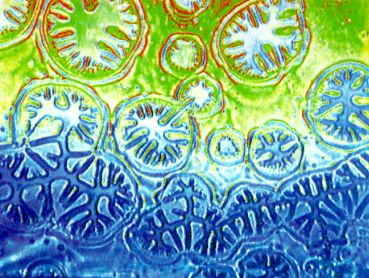
or
or some other non-spidery form taken by "viscous fingering?"
I mean, there are lumpy viscous fingerings, and weird smoke-vortexy looking ones, and others that just don't quite fit. Spiders on the other hand are pretty consistent across the boards in terms of their very definite Lichtenberg look and other electrical formations.
Aside from which, when we look at fairly specific examples of "spiders" the viscous fingering model seems to break down... Most of the spiders appear to have been "excavated." How exactly would this be done via "viscous fingering?" And where did said excavated material go? I see no flood plains or other escape routes for fluids. And as you've noted, the very nature of its "over hill and dale" routine defies gravity in ways that fluids simply CAN'T. To that end, fluid dynamics have been all but nullified as a reasonable and valid option. Unless we're saying that physics works differently in this ONE REGION of ONE PLANET in the solar system and in the universe.
Hoes does one explain fluids flowing up mountains and down the other side rather than pooling around them, or flowing around them? I simply can't see that as a viable option. It defies physics in a way that really makes no sense. Whereas an arc of electricity has no such compunctions, it just needs discharge points and a conductive channel to flow. It doesn't care about topography, it cares about conductivity and ionization channels. It machines material from surfaces in the lab, if you look up Electrical Discharge Machining. It literally ejects or vaporizes the material, either spreading it finely over the saurface, beading it, or completely vaporizing it and ejecting it into the atmosphere (or theoretically into space, on the large scale; which I might add could account for the large number of martian fragments that seem to like to fall to earth all the time as meteorites, etc.).
I just worry that the viscous fingering and other fluid dynamics are red herrings. I mean unless we're completely discounting gravity...? How else does one explain the figures' gravity defiance? Same thing with rilles and other carved features on Mars that run "over hill and dale." They simply CAN'T be carved by fluids. Asteroids don't produce snaky ravines. What else then is there that's so blatantly gravity-defying aside from Electrical processes? I disregard volcanic or tectonic "fault lines." Since these are not jagged or "cracked" features but smoothly sculpted features carved in stark relief. There are also many examples of pits scoops and gouges in volcanically neutral areas. Tectonics don't make sense since they're separate features with NO connecting faults or cracks aside from an imaginary line drawn down their length. I'm not completely out of favor wit h the multiple asteroid pieces in a line theory, however, there is no visible ejecta in the vicinity as would be expected from a ballistic/projectile impact.
Getting back to spiders though. Consider:
They ALWAYS appear to be thin and snaky, not bulbous or blobby:
http://www.martianspiders.com/eo1201762b.jpg.htm
They appear to definitely be a cratering phenomenon:
http://www.martianspiders.com/may2003/e1300520.jpg.htm
http://www.martianspiders.com/eo1102686a.jpg.htm
They often appear to be intimately associated with black streaking (I believe this is a direct analogy to the black streaking left as electrical dust devil tracks.):
http://www.martianspiders.com/e0702165b.jpg.htm
http://www.martianspiders.com/eo900547.jpg.htm
http://www.martianspiders.com/e0800043.jpg.htm
The black streaking seems more consistent with electrical activity or geysers than with any type of "viscous fingering." And we must consider ALL features of the region as likely being interconnected especially when you're getting the blackening directly over and highly associated with the spiders. One can't help but put them together... Since it seem hard to divorce them from each other in many occasions. So any theory seems to need to address ALL related issues in the region to truly have explanatory power. I think the electrical interpretation more accurately can deal with ALL features and not just one or two disparate features. Occam's Razor may apply here. Why explain via 2-4 processes what can be explain with only a single entity (electricity)? Simplify man, simplify! Or was that Semper Fi? Just kidding.
Ohh, right, and how does "fingering" explain this:
http://www.martianspiders.com/e0701468.jpg.htm
Looks to me like a rather massively electrified field. They're not your typical lichtenbergs. But they do still resemble electricity. And much moreso than "viscous fingering, etc." I also would doubt if these features exhibited "over hill and dale" behavior as well. Which would be consistent with electrical arcing, and not much else due to its essentially gravity defying nature. We can also see that not all of the figures are directly connected to each other, but they are internally consistent with each other. So, they're most likely not river systems, unless rivers can magically pick up, fly a few hundred feet and resume...? I somehow doubt it.
Likewise massive lichtenberg-like scarring fields:
http://www.martianspiders.com/eo900407c.jpg.htm
So, remind me how "viscous fingering" works on this scale again? How many "central points" for the fingering are there in this picture? A few hundred? I just don't see fingering accounting for this with no anomalous blobby figures or other non-Lichtenberg figures.
As to the other comment about why is it that electricity wouldn't create a deeper cut in the middle? Well, it just doesn't. Did I show you the picture of lightning on a golf course?
There isn't any central gouge or crater. Just a giant Lichtenberg burned into the grass.
So, there's really no problem with electrical interpretation (except that we may have to redefine a few things about planetary geology in light of ELECTRICAL evidence, which when you start looking is QUITE strong). The same thing happens with lightning on Earth. You get a massive charge in the ground, an equally massive and opposite charge in the air, you get a positive streamer from the ground connecting to a negatively charged stepped leader from the air. Where they connect you have an ionized channel and current flows until the charge is balanced. As we've seen from Lichtenberg formation, this is exactly how Lichtenbergs are formed in the lab. You get a massive charge in the acrylic, it's tapped with a conductive channel and a massive scarring discharge ensues. Not especially NEW stuff. Only in the realm of planetary geology. ;o)
Hope that clears up some stuff for ya'. Maybe now ya' see my point of view. And I'll grant Nick Hoffman that the current magnetosphere may be too weak to preferentially charge the planet. But in the past it may have had a much stronger magnetosphere which COULD have charged the surface via charged particle acceleration in the Birkeland electric currents. Even today, it's been noted that there are large magnetic bands/patches in the southern hemisphere/atmosphere.
Cheers,
~Michael
Space/Science » in reply to re: active geyser vs passive spot
re: active geyser vs passive spot
The whole thread (86 posts)
- The Geysers Of Mars
- re: The Geysers Of Mars
- re: The Geysers Of Mars
- This version of the story...
- re: Image from Orbit
- Maybe they're dust devils
- Hugh Kieffer deserves the credit
- the "geyser" image
- re: the "geyser" image
- CO2-water clathrates to explain the Martian spiders.
- re: They're everywhere!
- I had a nightmare like that once
- To each his own
- re: To each his own
- active geyser vs passive spot
- re: active geyser vs passive spot
- re: active geyser vs passive spot
- Mars does not have a bipolar magnetosphere
- re: active geyser vs passive spot
- re: active geyser vs passive spot
- re: active geyser vs passive spot
- re: active geyser vs passive spot
- re: active geyser vs passive spot
- Improved html with image (hopefully)
- re: active geyser vs passive spot
- active geyser vs passive spot
- re: To each his own
- re: Unpredictable
- Meanwhile, high above the Red Planet...