
"I will add more on why I believe there is a conclusive reason to act on anthropogenic global warming."
But is a possible rise of 59 cm within 100 year, a reason to act now?
The IPCC estimate is between 18 and 59 cm. A 18 cm rise wouldn't indicate any reason to act now, anymore than we should have acted in the early 1900's to the actual rise in sea in the 20th Century. It doesn't seem to me that you could make a case that people living in say 1910 made some mistake in not acting at that time. And therefore, I see little reason that people living at 2050, will judge us as making a mistake in not acting on this possible threat.
"Church and White (2006) found a sea-level rise from January 1870 to December 2004 of 195 mm, a 20th century rate of sea-level rise of 1.7 ±0.3 mm per yr and a significant acceleration of sea-level rise of 0.013 ± 0.006 mm per year per yr."
http://en.wikipedia.org/wiki/Sea_level_rise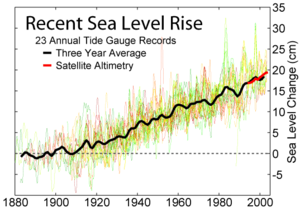
And it's quite possible that those living at 2050 could determine we made a mistake in acting if we choose to do something about this. What would their judgment of us be, if we spent a lot money and time on solving this apparent problem as compared to doing things about other problems?
I look forward to your other reasons to act on anthropogenic global warming, but I don't need any further reasons for why we should be increasing the amount of nuclear power generation and also improving ways of dealing with radioactive waste.
Increasing significantly the amount electrical power generated by nuclear energy is the best way of reducing air pollution and lowering global CO2 emission.
Reducing the costs of solar power would also a good thing, but I don't understand why solar power hasn't already significantly lowered in it's cost- I don't have enough understanding of the technical reasons of what is the barrier which preventing this lowering of costs. But obviously regardless of the cost issue, solar power isn't THE ANSWER but rather could be part of the solution.
And finally, I would say that countries that signed Kyoto, can be judged now [instead at 2050] as to have made a huge mistake. We could debate about the amount money they have wasted, but it's easily in the hundreds of billion with no effective result. I think this number is a 400 billion and if these country had instead spend 400 billion their space programs it would had a better result [possible even in the sense of solving problems related to global emissions of CO2]. But instead of space program- say if did more in others areas- say doing something about UHI or something about global poverty, or simply tax their citizens less.
Space/Science » in reply to Part 1: Global Warming and Sea Level Change READ TO THE END before responding
re: Part 1: Global Warming and Sea Level Change READ TO THE END before responding
The whole thread (59 posts)
- Part 1: Global Warming and Sea Level Change READ TO THE END before responding
- Temperature rise
- How much new arable land becomes available due to a global warming cycle?
- For temperature rise on the low side of the range...
- The world will definitely be worse, much worse.
- re: Part 1: Global Warming and Sea Level Change READ TO THE END before responding
- Thermocline and temperature structure of the ocean
- Thermal expansion of ocean water.
- re: Global Warming and Sea Level Change
- re the antarctica data...
- Okay, are you sure you put the right link?
- I will go over the points in detail later today, but let me just say this now
- sea ice extent currently is BELOW the recent mean
- Ocean temperature update
- Arrrrgh, not sure how it became IIPC it should read IPCC (n/t)