
"The Sun.
The "Solar Constant" isn't constant. Over Billions of years the Sun, like most stars, gradually gets hotter as it "burns" its nuclear fuel supply. Over time, Gaia must dial-down the amount of Greenhouse gas in the atmosphere to keep the temperature steady.
That's the straight answer."
But the graph you showed isn't over a time period of billions of years:
"The Cambrian is a geologic period and system that began about 542± 0.3 Ma (million years ago) ...."
Mean atmospheric CO2: 4500 ppm
Mean surface temperature: 21 °C
http://en.wikipedia.org/wiki/Cambrian
And on your graph last very warm warmest period in last 500 million years was about 75 million years ago:
"The Paleocene or Palaeocene, "early dawn of the recent" is a geologic epoch that lasted from 65.5 ± 0.3 Ma to 55.8 ± 0.2 Ma (million years ago)."
...
The early Paleocene was cooler and dryer than the preceding Cretaceous, though temperatures rose sharply during the Paleocene–Eocene Thermal Maximum. "
http://en.wikipedia.org/wiki/Paleocene
Paleocene–Eocene Thermal Maximum:
"The Paleocene/Eocene boundary, 55.8 million years ago, was marked by the most rapid and significant climatic disturbance of the Cenozoic Era. A sudden global warming event, leading to the Paleocene-Eocene Thermal Maximum (PETM,..."
...
"The Paleocene-Eocene Thermal Maximum lasted around 20,000 years, and was superimposed on a 6 million year period of more gradual global warming,[6] peaking later in the Eocene at the "Eocene climatic optimum". Other "hyperthermal" events can be recognised during this period of cooling, including the Elmo event (ETM2). During these events, of which the PETM was by far the most severe, around 1,500 to 2,000 gigatons of carbon were released into the ocean/atmosphere system over the course of 1,000 years. This rate of carbon addition almost equals the rate at which carbon is being released into the atmosphere today through anthropogenic activity."
http://en.wikipedia.org/wiki/Paleocene%E2%80%93Eocene_Thermal_Maximum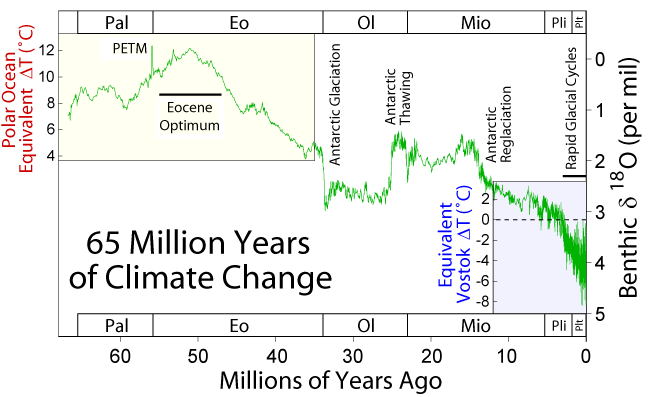

Another graph:
So, in terms last 100 million years, the sun age should not be a significant factor. Though one shouldn't suppose the sun was constant in the last 100 million years, or suppose the Sun will stay constant for the next 100 or 1000 years.
The sun at moment still doesn't have much sun spot activity:
It had tiny one the other day but it faded.
Space/Science » in reply to What saved the Earth?
re: What saved the Earth?
The whole thread (62 posts)
- A warmer Finland
- re: A warmer Finland
- re: A warmer Finland
- Obviously...
- Can't stop that CO2
- The Larsen Ice Shelf
- "Glasser acknowledges that global warming had a major part to play in the collapse," (n/t)
- Media Hype on ´Melting´ Antarctic Ignores Record Ice Growth
- good job linking to a March report instead of current ones
- It isn't just about sea ice. It's the total mass balance of Antarctica
- and the models say increased snowfall in the Antarctic, so no contradiction
- Okay, then Greenland.
- It's the IPCC that counts
- I guess that settles it then.
- never happened
- re: never happened
- speaking of livelihoods, my bet offer is open
- Based on what results?
- re: speaking of livelihoods, my bet offer is open
- speaking of livelihoods, my bet offer is open
- There is a reason it was originally named GREENLAND and not ICELAND. (n/t)
- re: never happened
- never happened
- I guess that settles it then.
- re: Okay, then Greenland.
- It's the IPCC that counts
- Okay, then Greenland.
- and the models say increased snowfall in the Antarctic, so no contradiction
- It isn't just about sea ice. It's the total mass balance of Antarctica
- good job linking to a March report instead of current ones
- Media Hype on ´Melting´ Antarctic Ignores Record Ice Growth
- "Glasser acknowledges that global warming had a major part to play in the collapse," (n/t)
- re: Obviously...
- re: Obviously...
- re: A warmer Finland
- Obviously...
- re: A warmer Finland
- re: A warmer Finland